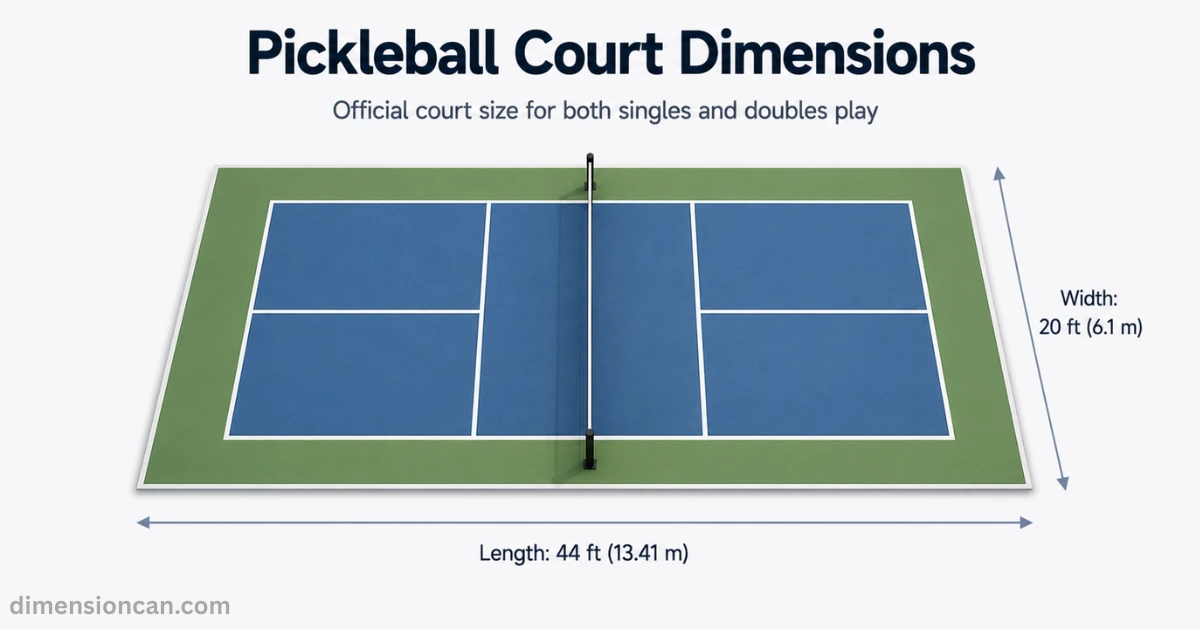
Pickleball is now America’s fastest-growing sport, and that growth means more backyards, gyms, and parks need accurate court dimensions. This guide breaks down every measurement, every zone, and every practical detail you need — in plain, simple language.
Official Pickleball Court Dimensions & Layout
Standard Pickleball Court Size (20 ft x 44 ft Explained)
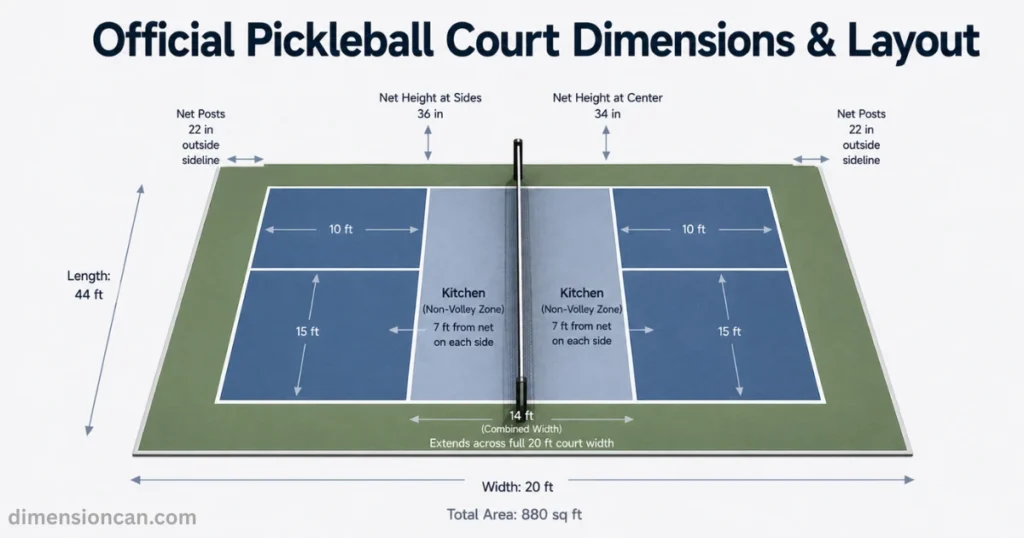
The playing surface is 20 feet wide and 44 feet long. This equals 880 square feet of total court area. Unlike tennis, there is no separate singles or doubles width — one size fits both formats.
Non-Volley Zone (“Kitchen”) Dimensions
The non-volley zone, commonly called the kitchen, extends 7 feet from the net on each side. This creates a 14-foot-wide zone that spans the full width of the court.
Players cannot volley the ball while standing inside this area. The kitchen is what makes pickleball strategy unique, since it forces soft, controlled shots near the net instead of aggressive smashes.
Service Court & Centerline Dimensions
Behind each kitchen line sits the service area, split into two boxes by a centerline. Each service box measures 10 feet wide by 15 feet deep. The centerline runs from the kitchen line to the baseline, dividing the right and left service courts.
Net Height and Net Post Dimensions
The pickleball net stands 36 inches high at the sidelines and dips slightly to 34 inches at the center. This small sag affects shot angles near the middle of the court.
Net posts sit 22 inches outside the sideline on each side, so the net spans the full 20-foot width plus a bit extra for anchoring.
More Posts:ZYN Can Dimensions: Size, Height & pouches Capacity (2026)
Total Space Required for a Pickleball Court
Minimum Space for a Backyard/Recreational Court
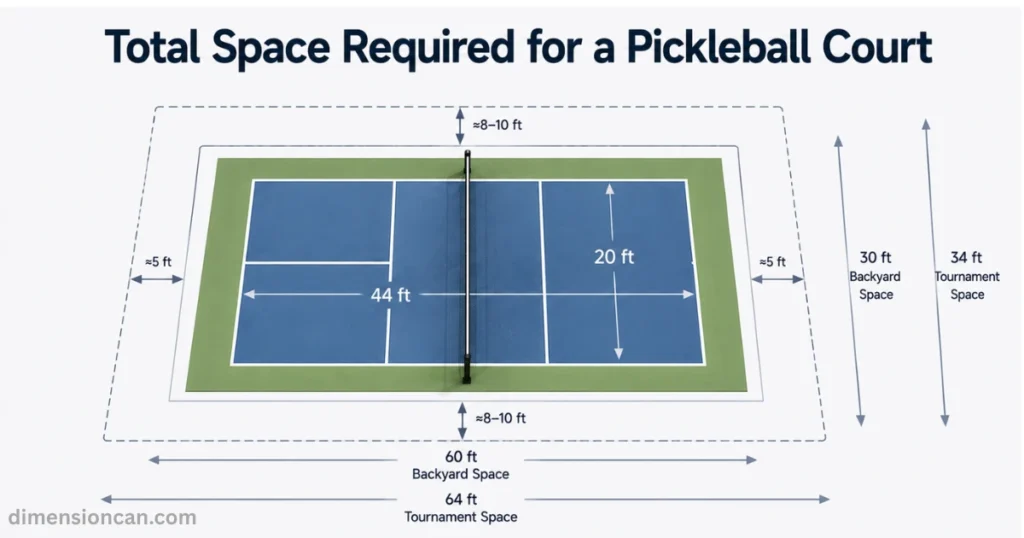
For a home court, the minimum recommended footprint is 30 feet by 60 feet. This gives roughly 5 feet of run-off on the sides and 8 to 10 feet behind each baseline.
Recommended Space for Regulation/Tournament Play
USA Pickleball recommends 34 feet by 64 feet for tournament-level courts. This wider buffer supports fast-paced play, sponsor signage, and space for line judges. Facilities hosting sanctioned events should follow this larger standard rather than the bare minimum.
Space Planning for Multi-Court Facilities
Clubs building multiple courts typically add a 10 to 12-foot buffer between adjacent courts for player safety and ball retrieval.
A four-court layout, for example, often needs a total footprint close to 120 feet by 128 feet, depending on fencing and spectator space. Planning this early avoids costly redesigns later.
Pickleball Court Dimensions Compared to Other Courts
Pickleball Court vs. Tennis Court Dimensions
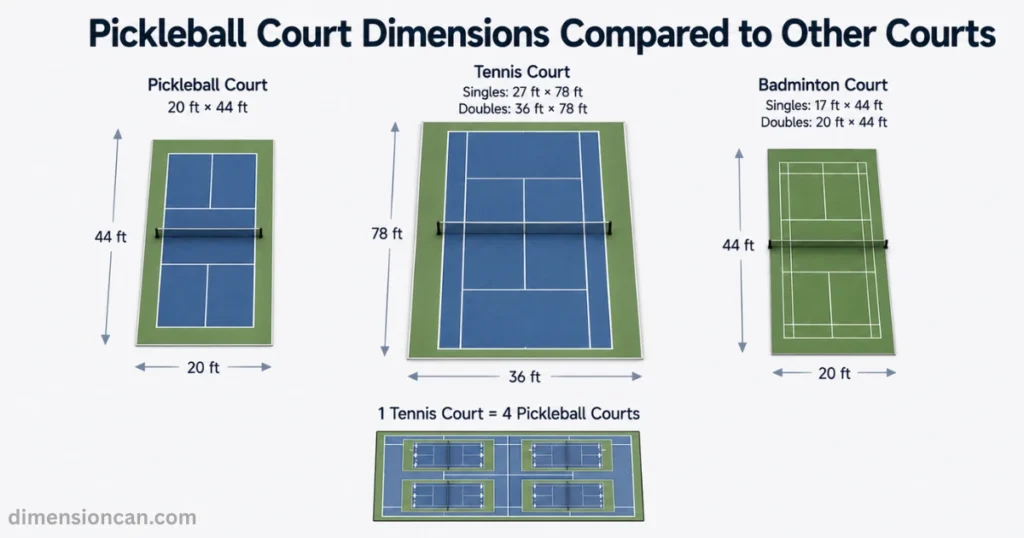
A tennis court measures 78 feet long by 27 feet wide for singles, and 36 feet wide for doubles — far larger than a pickleball court’s 20-by-44 footprint. This size gap is exactly why tennis courts convert so easily into pickleball space.
Pickleball Court vs. Badminton Court Dimensions
A badminton court is 44 feet long, matching pickleball’s length, but only 20 feet wide for doubles and 17 feet for singles. The similar length is not a coincidence: pickleball’s early rules borrowed directly from badminton’s layout.
How Many Pickleball Courts Fit on One Tennis Court
One standard tennis court fits four pickleball courts side by side with minimal modification. This is the single biggest reason parks departments and private clubs across the U.S. have converted underused tennis courts into pickleball hubs since 2020.
More Posts:Ammo Can Dimensions: Size ,Height & Storage CAPACITY (2026)
Indoor vs. Outdoor Pickleball Court Dimensions & Surfaces
Do Indoor Courts Have Different Dimensions?
No. Indoor pickleball courts use the exact same 20-by-44-foot layout as outdoor courts. The one added requirement is ceiling clearance, with USA Pickleball recommending at least 20 feet of overhead space for lob shots and serves.
Best Surface Materials by Court Type
Outdoor courts typically use acrylic-coated asphalt or concrete for durability against weather. Indoor courts favor hardwood, polypropylene tile, or cushioned vinyl, which reduce joint strain during long play sessions.
Estimated Cost by Surface and Court Size
A basic backyard court using painted asphalt can cost between $8,000 and $15,000. Adding cushioned acrylic surfacing, fencing, and quality nets can push costs to $25,000 or more. Indoor conversions vary widely based on existing flooring but generally cost less than new outdoor construction, since walls and roofing already exist.
More Posts:Standard Bathtub Dimensions: A Complete Size Guide for Every Bathroom
FAQs About Pickleball Court Dimensions
What are the official pickleball court dimensions?
A regulation court is 20 feet wide by 44 feet long, the same size for singles and doubles.
How big is a pickleball court in meters?
A pickleball court measures 6.1 meters wide by 13.41 meters long.
How much space do you need around a pickleball court?
Plan for at least 30 by 60 feet total, with 34 by 64 feet preferred for competitive play.
Can you fit a pickleball court on a tennis court?
Yes. One tennis court fits four pickleball courts with minor line adjustments.
What is the kitchen (non-volley zone) size in pickleball?
The kitchen (non-volley zone) extends 7 feet from the net on each side, creating a 14-foot-wide zone.
How high is a pickleball net?
The net stands 36 inches at the sidelines and 34 inches at the center.
Are indoor pickleball court dimensions different from outdoor?
No, the playing dimensions stay the same. Only the ceiling height requirement changes for indoor courts.
What is the cheapest way to build a pickleball court at home?
Painting regulation lines on an existing driveway or flat concrete pad is the lowest-cost option, often under $500 for paint and a net alone.

James Walker is a content researcher and writer specializing in dimensions, measurements, size comparisons, and conversion topics. He creates clear, practical, and easy-to-understand guides that help readers visualize and understand real-world measurements.