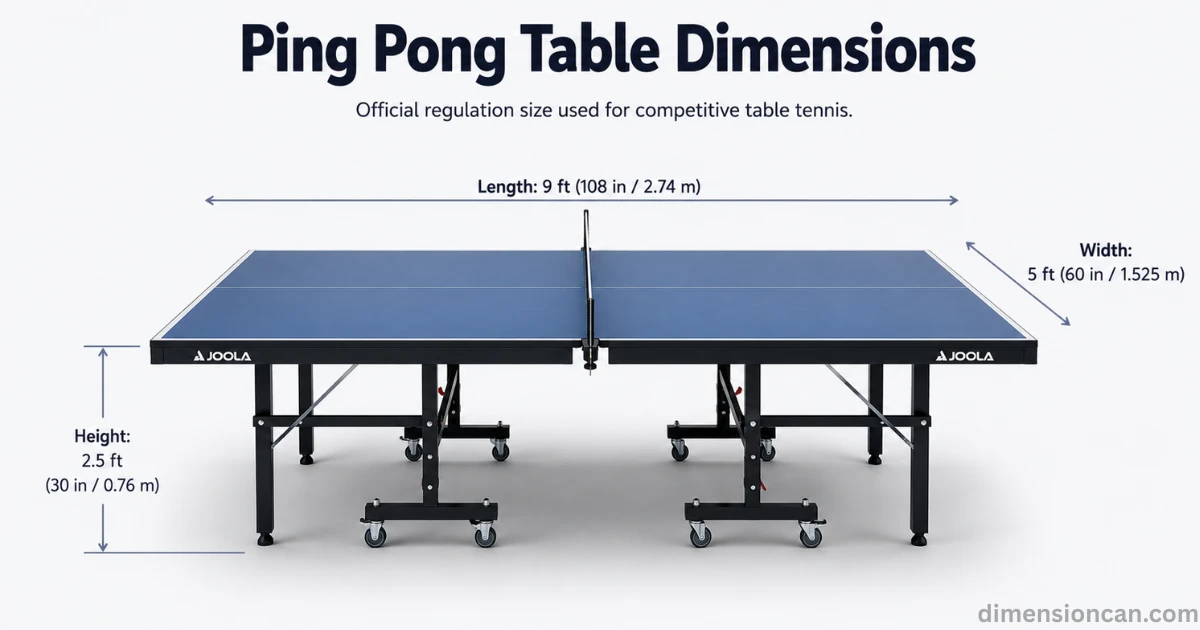
But picking the right table involves more than one number. Room size, ceiling height, and how you plan to play all shape the real decision. This guide covers the official specs, plus the space and room details most guides skip.
Standard Ping Pong Table Dimensions
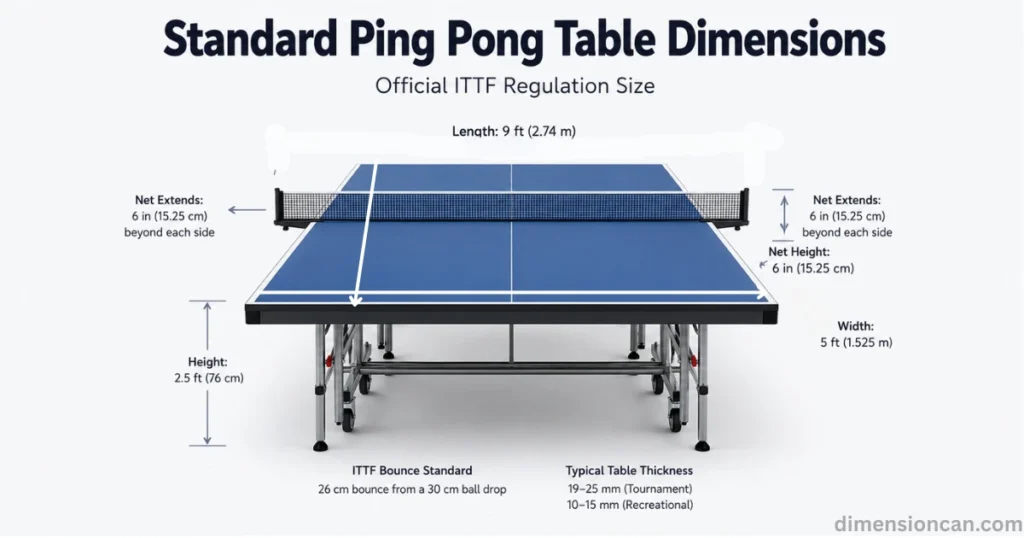
The International Table Tennis Federation (ITTF) sets the official ping pong table size used in the Olympics and every sanctioned tournament worldwide.
Length, Width and Height
- Length: 9 feet (2.74 meters)
- Width: 5 feet (1.525 meters)
- Height: 2.5 feet (76 cm)
These numbers never change, whether you’re buying a table for a home game room, a rec center, or a club.
Net Height and Playing Surface
The net sits at 6 inches (15.25 cm) above the table surface. It stretches 6 inches beyond each side of the table too. The net divides the table into two equal courts, and its height stays constant across the entire width.
More Posts:Pool Table Dimensions: The Complete Size Guide (2026)
Table Thickness and Bounce Standard
Thickness isn’t fixed by rule. Instead, the ITTF requires a 26 cm bounce when a ball drops from 30 cm above the surface. Most tournament-grade tables use 19mm to 25mm thick tops, since thicker surfaces bounce more consistently. Thinner, budget tables (10mm–15mm) work fine for casual backyard rallies but feel less predictable during fast rallies.
How Much Space You Need for a Ping Pong Table
Minimum Clearance Around the Table
Players need breathing room on every side. A safe rule of thumb:
- Behind each end: at least 5 feet
- On each side: at least 3 feet
This brings the total footprint to roughly 19 feet by 11 feet for comfortable singles or doubles play.
Recommended Room Size
For a genuinely enjoyable match, aim for a room at least 16 feet by 10 feet, which most table tennis retailers consider the workable minimum. A 20-foot by 12-foot room gives true tournament-style clearance, with zero cramped corners or wall collisions.
Ceiling Height Requirements
Ceiling height matters just as much as floor space. Table tennis rallies include high lobs and smashes, so a ceiling height of at least 8 feet is the practical baseline. Basements with low overhead beams, ductwork, or drop ceilings under 8 feet can genuinely limit shot variety, even if the floor space checks every box.
Ping Pong Table Size by Room Type
Garage Ping Pong Table Setup
Garages are a popular choice because a standard two-car garage (about 20 feet by 20 feet) comfortably fits a regulation table with room to spare. Watch for support poles, garage door tracks, and parked vehicles, which quietly eat into usable width.
Basement Room Size
Basements offer privacy and insulation from noise, but support columns, low ceilings, and HVAC ducts are common obstacles. Measure the clear, obstruction-free rectangle before assuming a regulation table will fit — many finished basements only leave 14 to 16 feet of usable length.
Best Table Size for Apartments
Apartments rarely offer 19 feet of clear space. A mini or 3/4-size table (roughly 6 feet by 3 feet) or a folding table that stores vertically after use solves this problem without sacrificing the fun of the game.
Regulation vs Mini vs Outdoor Table Dimensions
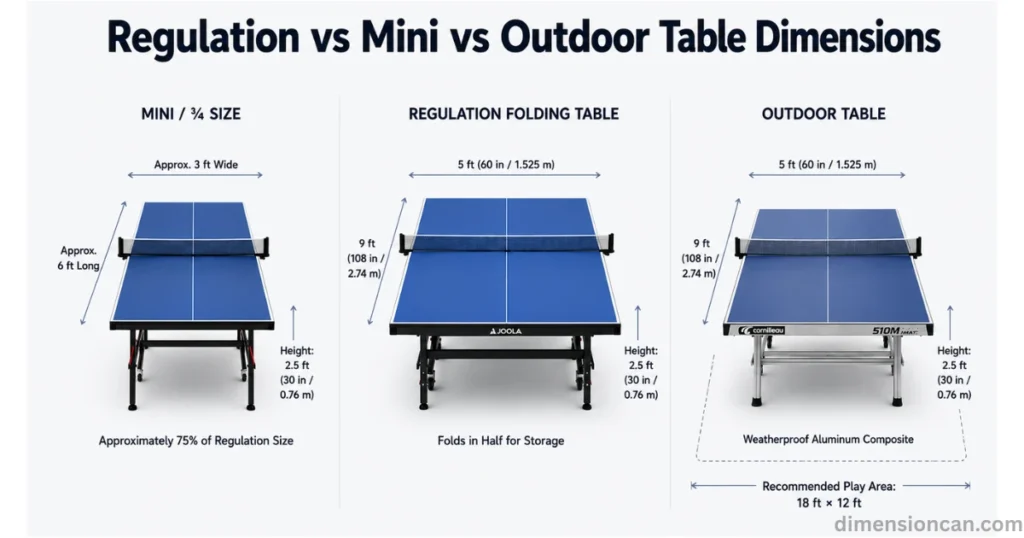
Not every table follows the 9-foot regulation standard, and that’s by design.
Mini and 3/4-Size Tables
Mini ping pong tables run about 75% of full size, typically near 6 feet by 3 feet, with a similar 2.5-foot height. These suit kids, beginners, and tight rec rooms, though serious players may find the smaller surface throws off timing when switching to a full table.
Folding Table Differences
Folding ping pong tables keep the same regulation 9×5 foot playing surface but fold in half for storage. This makes them the top pick for multi-purpose rooms and garages shared with cars or storage.
Outdoor Ping Pong Table Dimensions
Outdoor tables stick to the same regulation dimensions but use weatherproof materials like aluminum composite. Outdoor setups need a flat, level surface and at least 18 feet by 12 feet of open space, away from wind gusts that can disrupt light plastic balls.
More Posts:Printer Paper Dimensions: The Complete Size Guide for U.S. Printing
Ping Pong Table Dimensions vs Other Game Tables
Ping Pong vs Pool Table Space
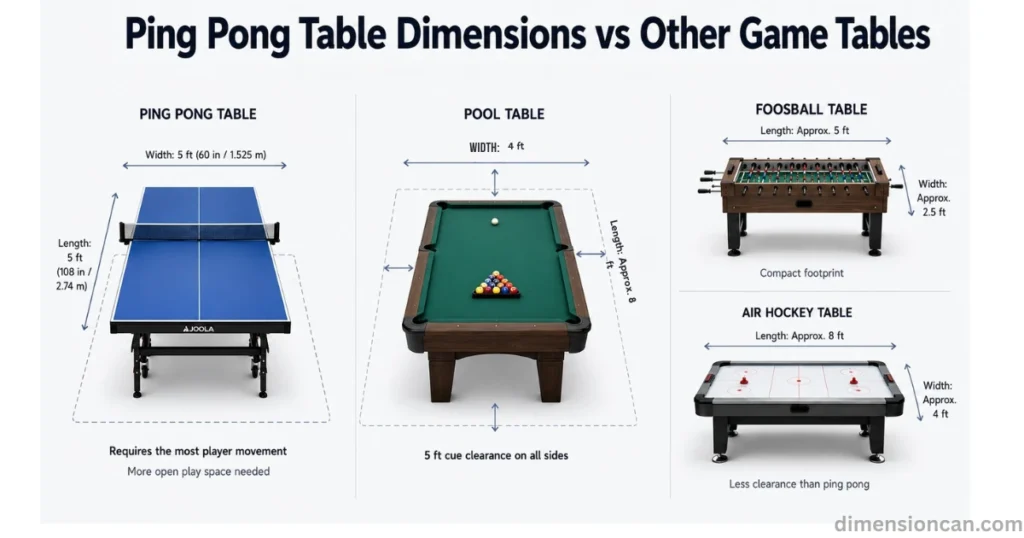
A standard pool table measures about 8 feet by 4 feet, smaller than a ping pong table, but it still needs 5 feet of cue clearance on all sides. Pool tables stay fixed in place, while ping pong tables demand more open floor because players constantly move side to side and backward.
Ping Pong vs Foosball and Air Hockey
Foosball tables run around 5 feet by 2.5 feet, and air hockey tables measure close to 8 feet by 4 feet. Both need far less clearance than table tennis, since neither game involves players stepping back from the table. If floor space is the biggest constraint, these alternatives pack more game variety into less square footage.
FAQs About Ping Pong Table Dimensions
What are the official ping pong table dimensions?
A regulation table measures 9 feet long, 5 feet wide, and 2.5 feet tall, per ITTF standards.
How much room do I need for a ping pong table?
Plan for at least 16 feet by 10 feet of clear floor space, with 19 by 11 feet ideal for full movement.
Can I fit a ping pong table in a small room?
Yes, with a mini table or folding table, both designed for tighter apartments and shared spaces.
What’s the difference between a regulation and mini table?
A mini table is about 75% the size of a regulation table, mainly built for casual or beginner play.
What ceiling height do I need for a basement table?
Aim for at least 8 feet of ceiling clearance to allow full lobs and smashes without hitting overhead obstructions.
Are there size alternatives for tight spaces?
Yes — folding tables, mini tables, and conversion toppers for existing dining or pool tables all work well.
How do ping pong dimensions compare to a pool table?
A pool table is smaller (8 × 4 feet) but needs similar side clearance; a ping pong table needs more space behind each end for player movement.

James Walker is a content researcher and writer specializing in dimensions, measurements, size comparisons, and conversion topics. He creates clear, practical, and easy-to-understand guides that help readers visualize and understand real-world measurements.