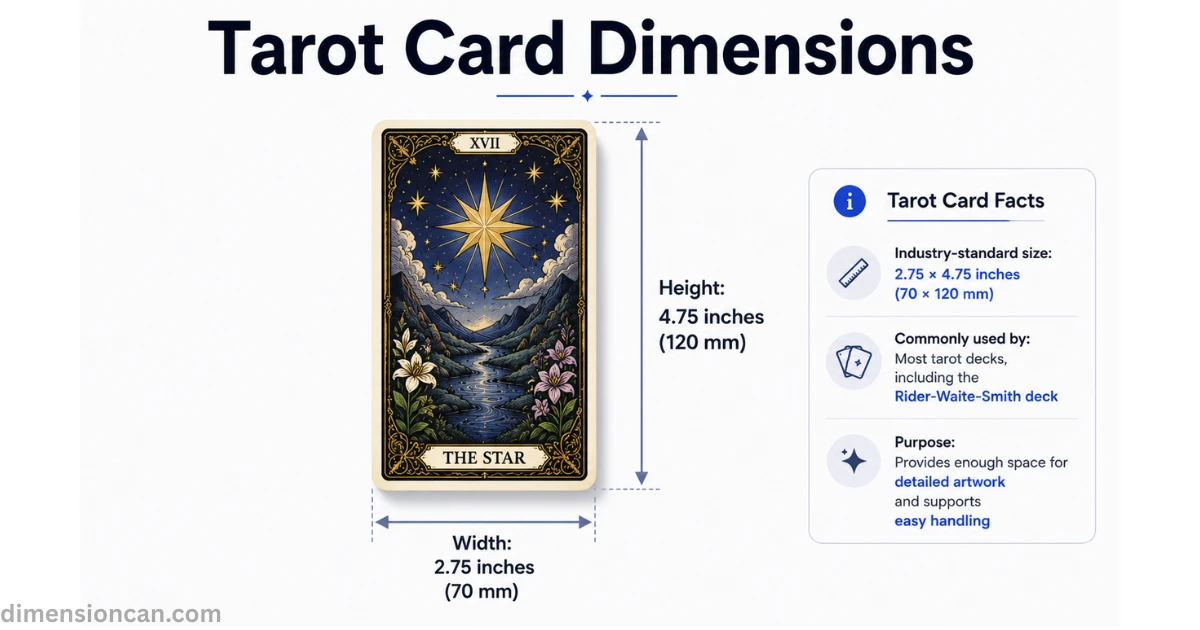
Standard tarot card dimensions are 2.75 × 4.75 inches (70 × 120 mm). This is the industry-standard size used by most tarot decks, including the Rider-Waite-Smith deck, and provides enough space for detailed artwork and easy handling.
This guide breaks down every standard tarot card size, why it exists, and how to pick the right one for you — no fluff, just the facts.
What Are Standard Tarot Card Dimensions?
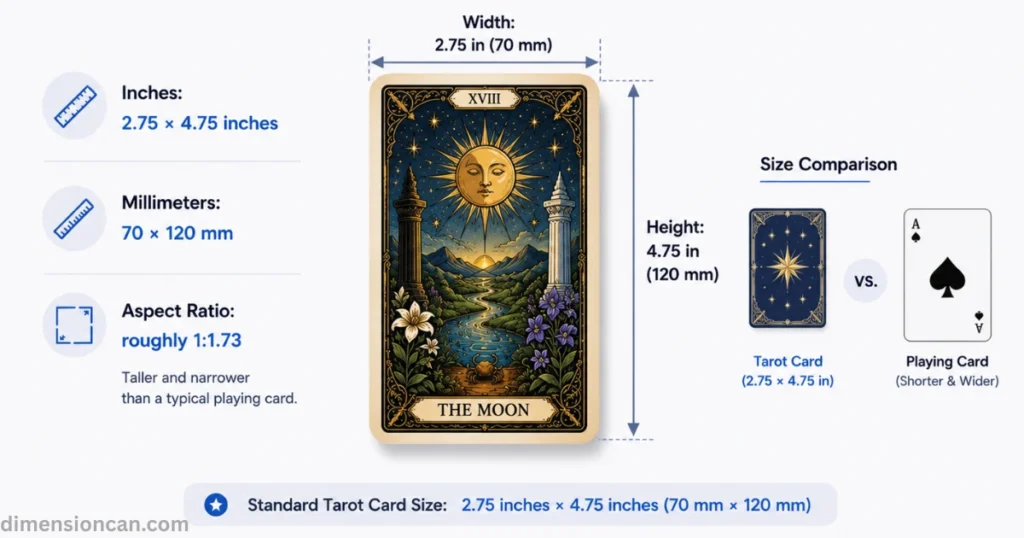
The standard tarot card dimensions are 2.75 inches by 4.75 inches, or 70mm by 120mm. This is the size you’ll find in most decks sold today, including the classic Rider-Waite-Smith deck.
Standard Tarot Card Size in Inches and Millimeters
In inches, that’s 2.75″ x 4.75″. In the metric system, it converts to 70mm x 120mm. Most manufacturers list both, since tarot is printed and sold worldwide.
This gives an aspect ratio of roughly 1:1.73, taller and narrower than a typical playing card. That extra height is the whole point — it makes room for detailed artwork.
Tarot Card Dimensions vs. Standard Playing Card Dimensions
A standard playing card, or poker-size card, measures 2.5″ x 3.5″ (63mm x 88mm). Tarot cards are noticeably taller and slightly wider.
That size difference matters. Tarot’s 78-card deck includes the Major Arcana and Minor Arcana, and each card often carries a title, a number, and layered imagery — details a smaller playing-card format simply can’t hold as clearly.
More Posts:Postcard Dimensions: Standard, Jumbo & Mini Sizes
Tarot Card Dimensions by Deck Type
Mini and Pocket Tarot Card Dimensions
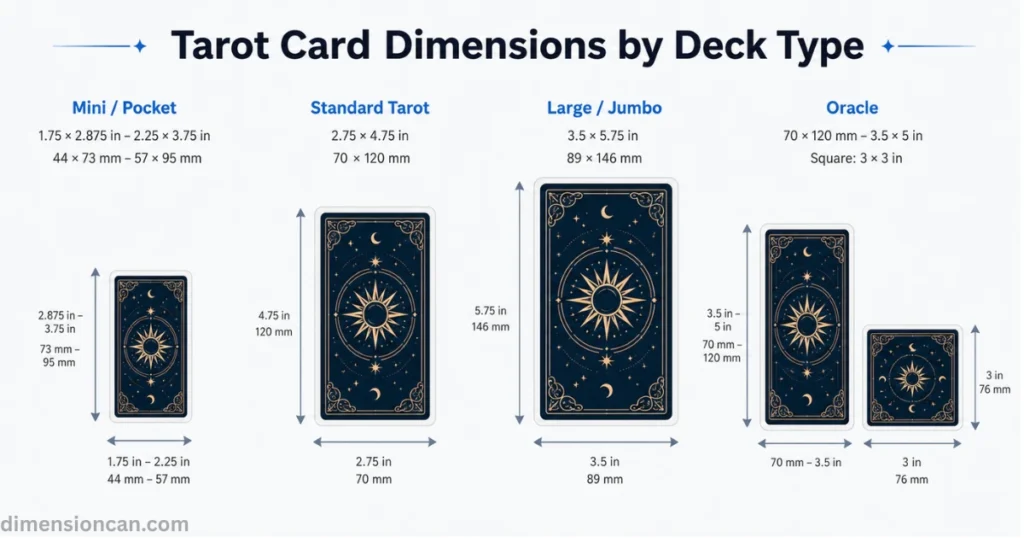
Mini tarot cards typically run from 1.75″ x 2.875″ up to about 2.25″ x 3.75″ (roughly 44mm x 73mm to 57mm x 95mm). Some pocket editions dip slightly smaller still.
These decks are built for portability. They slide into a bag or coat pocket, which makes them popular for travel readings and quick daily draws.
Large and Jumbo Tarot Card Dimensions
Large tarot cards usually measure around 3.5″ x 5.75″ (89mm x 146mm), sometimes bigger depending on the publisher.
Jumbo formats favor visual impact over convenience. Illustrators use the extra canvas to add fine detail, and readers with vision difficulties often find larger decks easier to read.
Shuffling a full 78-card jumbo deck, though, takes more hand strength and table space.
Oracle Card Dimensions vs. Tarot Card Dimensions
Oracle cards are a different animal from tarot. They don’t follow a fixed 78-card structure, and their dimensions vary far more widely — anywhere from standard tarot size (70mm x 120mm) up to 3.5″ x 5″ or even square formats like 3″ x 3″.
If a deck is labeled “oracle,” don’t assume it matches tarot sizing. Always check the listed dimensions before buying sleeves or a box for it.
More Posts:Pokemon Card Dimensions: Standard, Japanese & Jumbo Sizes
How Tarot Card Dimensions Affect Shuffling, Reading, and Storage
Hand Size and Shuffle Comfort by Card Dimension
Bigger cards need bigger hands. A standard 2.75″ x 4.75″ deck works comfortably for most adults, but if your hands are on the smaller side, a mini or bridge-size deck may shuffle far more smoothly.
Readers with larger decks often switch to an overhand shuffle or a simple cut-and-mix method instead of a traditional riffle shuffle, since jumbo cards resist bending.
Sleeve, Box, and Storage Compatibility With Tarot Card Dimensions
This is where a lot of buyers get caught out. Standard tarot sleeves are cut for the 2.75″ x 4.75″ size — a mini or jumbo deck usually won’t fit them.
Before buying protective sleeves or a storage box, measure your specific deck, not just the “tarot” label on the package.
Tarot Card Dimensions for Custom Printing and Deck Design
Bleed, Safe Zone, and Print-Ready Tarot Card Dimensions
For a standard 70mm x 120mm card, extend your background artwork to at least 76mm x 126mm to account for bleed. This prevents white edges from appearing after the card is trimmed.
Keep all essential text, titles, and border elements inside a safe zone well within the final 70mm x 120mm boundary. Files should be set up at 300 DPI — anything lower will print blurry, and upscaling a low-resolution image afterward won’t fix it.
Cardstock, Finish, and Corner Radius by Dimension
Most professional tarot printers use 300-350gsm cardstock, finished in either a smooth, linen, or matte laminate. Thicker stock holds up better to daily shuffling, particularly on larger card sizes where more surface area means more flex.
Standard corner radius for tarot and oracle decks is typically R3.5 to R4. Custom radii are available, but standard rounding keeps production costs and turnaround time lower.
FAQs About Tarot Card Dimensions
What is the standard tarot card size?
The standard tarot card size is 2.75 inches by 4.75 inches (70mm x 120mm). This is the dimension used by most major tarot publishers.
How big are tarot cards compared to regular playing cards?
Tarot cards are larger than regular playing cards. A standard playing card measures 2.5″ x 3.5″, while a tarot card measures 2.75″ x 4.75″ — taller and slightly wider.
Are all tarot decks the same size?
No. While 2.75″ x 4.75″ is the industry standard, decks also come in mini (around 1.75″ x 2.875″), large (around 3.5″ x 5.75″), and other custom dimensions depending on the publisher.
What size are mini tarot cards?
Mini tarot cards typically measure between 1.75″ x 2.875″ and 2.25″ x 3.75″ (44mm x 73mm to 57mm x 95mm).
Do tarot cards and oracle cards have the same dimensions?
Not necessarily. Oracle cards don’t follow a fixed size standard the way tarot does, and dimensions can range from standard tarot size up to larger formats or even square cards.
What size sleeves fit standard tarot cards?
Sleeves labeled for “tarot size” are cut to fit the 2.75″ x 4.75″ standard. Always check a deck’s exact measurements before buying sleeves, since mini and jumbo decks need different sizes.
What DPI should I use to print custom tarot cards?
Print-ready tarot card files should be set at 300 DPI with bleed extending the artwork to roughly 76mm x 126mm for a standard-size card.

James Walker is a content researcher and writer specializing in dimensions, measurements, size comparisons, and conversion topics. He creates clear, practical, and easy-to-understand guides that help readers visualize and understand real-world measurements.