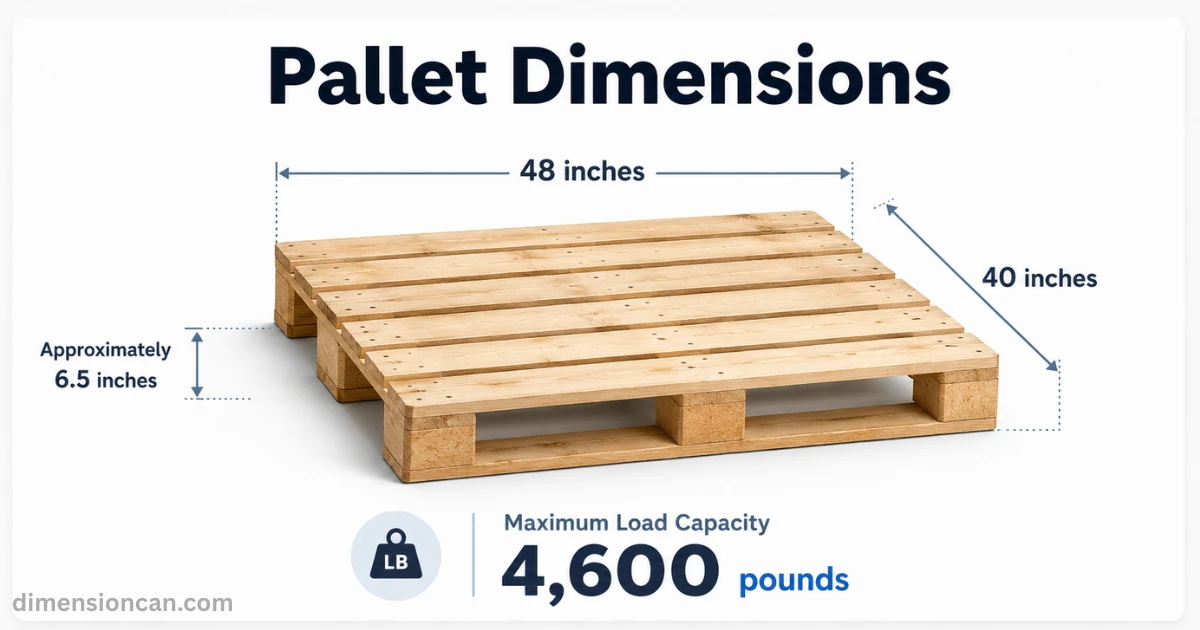
The standard U.S. pallet measures 48 × 40 inches, stands about 6.5 inches tall, and supports up to 4,600 pounds. These dimensions make it the most widely used pallet size for shipping, warehousing, and material handling across North America.
This one size accounts for over 30% of all pallets built nationwide each year, and choosing wrong means wasted space or rejected shipments.
Standard Pallet Dimensions
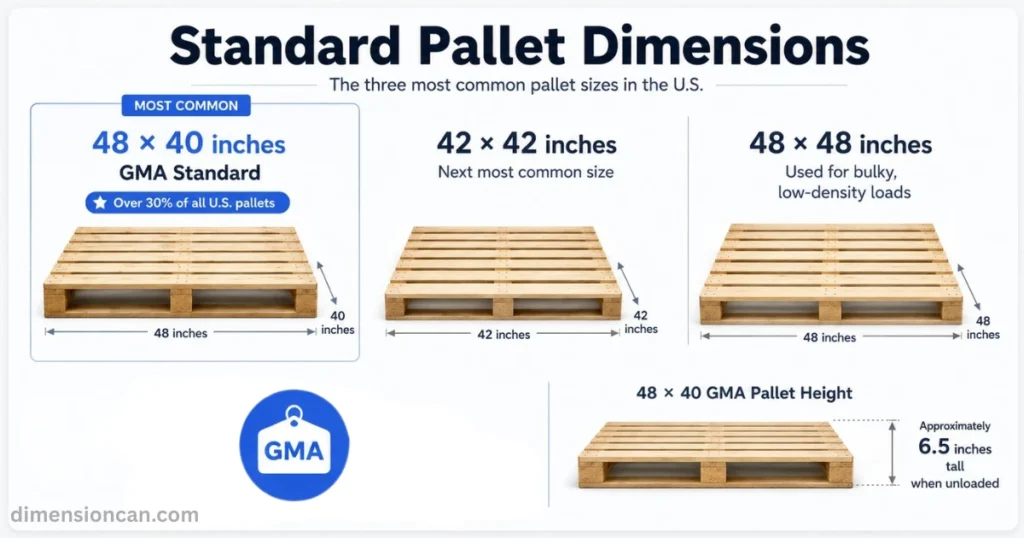
The standard pallet dimensions trace back to the Consumer Brands Association, formerly the GMA (Grocery Manufacturers Association). That history is why this pallet is still called a GMA pallet on most loading docks.
Three sizes dominate the U.S. market:
- 48″ x 40″ — the GMA standard, over 30% of all U.S. pallets
- 42″ x 42″ — the next most common size
- 48″ x 48″ — used for bulky, low-density loads
A standard 48×40 pallet stands roughly 6.5 inches tall unloaded. Its deck boards typically measure 3.5 inches wide by 5/16 inch thick, and weight capacity runs up to 4,600 pounds.
Pallet Dimensions by Type
Stringer Pallet Dimensions
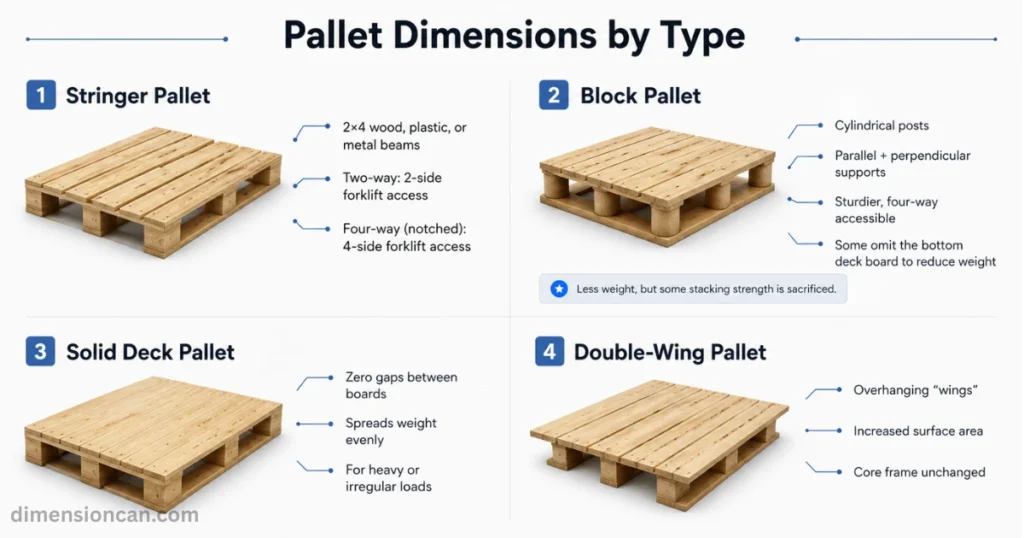
Stringer pallets rely on 2×4 wood, plastic, or metal beams running between the deck boards. These stringers carry the load weight.
They come in two-way and four-way designs. Two-way pallets accept a forklift from two sides only. Four-way (notched) pallets accept entry from all four, which speeds up handling in busy warehouses.
Block Pallet Dimensions
Block pallets use cylindrical posts instead of stringers, combined with both parallel and perpendicular supports. This build makes them sturdier and naturally four-way accessible.
Some block pallets skip the bottom deck board to cut weight, which trades off some stacking strength.
Solid Deck and Double-Wing Pallet Dimensions
A solid deck pallet has zero gaps between boards. The unbroken surface spreads weight evenly, which matters for heavy or irregular loads prone to shifting.
Double-wing pallets extend deck boards past the stringers, creating overhanging “wings” on each side, increasing surface area without altering the core frame.
More Posts:Twin Bed Dimensions: Size, Room & Mattress Guide (Inches & Feet)
Pallet Dimensions by Region
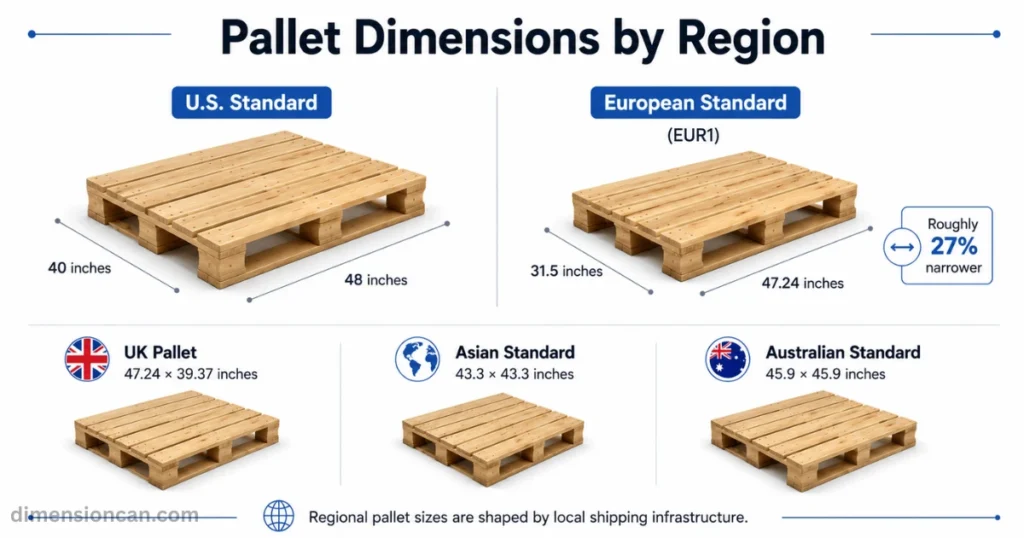
The U.S. pallet measures 48 x 40 inches. The European standard, the Euro pallet (EUR1), measures about 47.24 x 31.5 inches — roughly 27% narrower.
Other regional standards: the UK pallet at 47.24 x 39.37 inches, the Asian standard at 43.3 x 43.3 inches, and the Australian standard at 45.9 x 45.9 inches — each shaped by local shipping infrastructure.
Pallet Height, Weight Capacity, and Load Limits
Standard 48×40 pallets run about 6.5 inches tall unloaded and support up to 4,600 pounds. Reinforced designs, like heavy-duty block pallets, carry more, but total stack height in transit typically stays under 87 inches for stability.
Manufacturing tolerance is a detail most guides skip. Pallets aren’t cut to exact measurements every time — small variances of a few millimeters in length, width, and height are standard across the industry.
Diagonal difference, which measures how “square” a pallet sits, gets checked separately to prevent instability.
More Posts:King Size Sheet Dimensions: Fitted, Flat & Pillowcase Sizes
FAQ’s About Pallet Dimensions
What is the standard pallet size in the USA?
The standard U.S. pallet size is 48 inches by 40 inches, known as the GMA pallet. It makes up more than 30% of all pallets used nationwide.
How tall is a standard pallet?
A standard 48×40 pallet stands about 6.5 inches tall before goods are loaded.
How much weight can a standard pallet hold?
A standard pallet typically holds up to 4,600 pounds, though this varies by material and build.
What is the difference between a US pallet and a Euro pallet?
A US pallet measures 48 x 40 inches. A Euro pallet measures about 47.24 x 31.5 inches, roughly 27% narrower than the US standard.
What is the difference between a stringer pallet and a block pallet?
Stringer pallets use support beams and often allow two-way forklift entry. Block pallets use cylindrical posts and typically allow four-way entry, making them more flexible to handle.
Conclusion
Pallet dimensions touch every part of shipping, from trailer space to freight pricing. The 48×40 GMA pallet remains the U.S. default, but pallet type, region, and weight capacity all matter just as much as the footprint itself.
Confirming these details before shipping, not after, is what keeps freight costs predictable and loads stable from dock to destination.

James Walker is a content researcher and writer specializing in dimensions, measurements, size comparisons, and conversion topics. He creates clear, practical, and easy-to-understand guides that help readers visualize and understand real-world measurements.