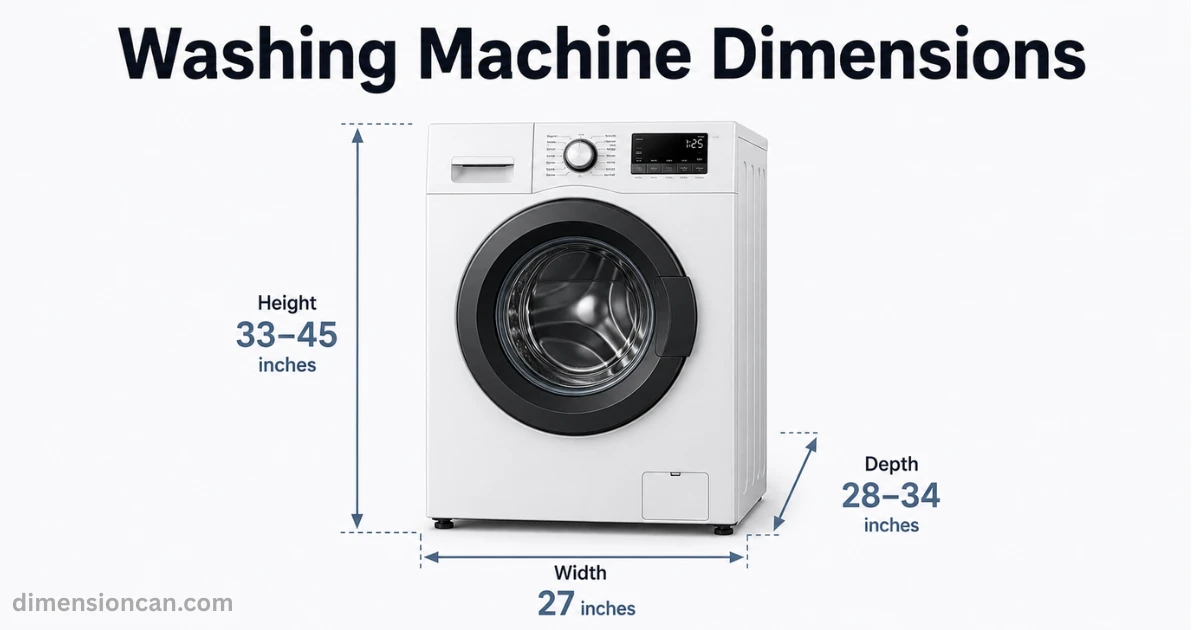
A standard washing machine measures about 27 inches wide, 28–34 inches deep, and 33–45 inches tall, depending on whether it’s a front-load or top-load model.
This guide breaks down standard washing machine sizes, brand-by-brand specs, and simple steps to measure your space correctly. No guesswork, no jargon — just the numbers you need.
Standard Washing Machine Dimensions by Type
Front-Load Washing Machine Dimensions
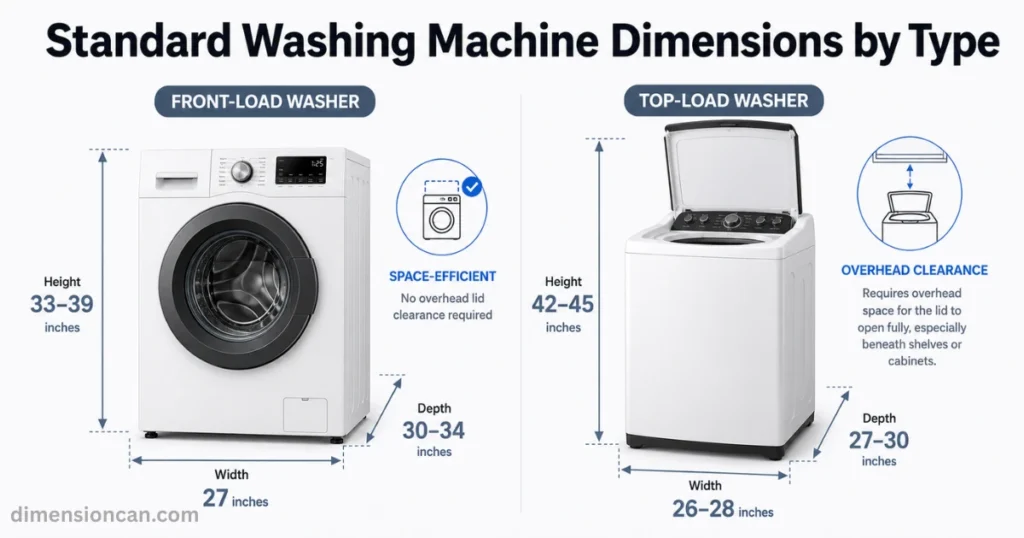
A standard front-load washer typically measures 27 inches wide, 33 to 39 inches tall, and 30 to 34 inches deep. Front-loaders are known for being space-efficient, since they don’t need clearance above the drum for a lid to open.
Top-Load Washing Machine Dimensions
A top-load washer usually runs 26 to 28 inches wide, 42 to 45 inches tall, and 27 to 30 inches deep. Because the door is on top, you’ll need overhead clearance to lift the lid fully — something easy to overlook if you’re installing under a shelf or cabinet.
Compact and Apartment-Size Washing Machine Dimensions
These units are usually 24 inches wide, making them narrower than standard models by roughly 3 inches. They’re a smart pick for tight laundry closets, stackable setups in small units, and portable washers that connect to a sink.
More Posts:Washer and Dryer Dimensions by Type, Brand & Clearance
Washing Machine Dimensions by Brand
Samsung Washing Machine Dimensions
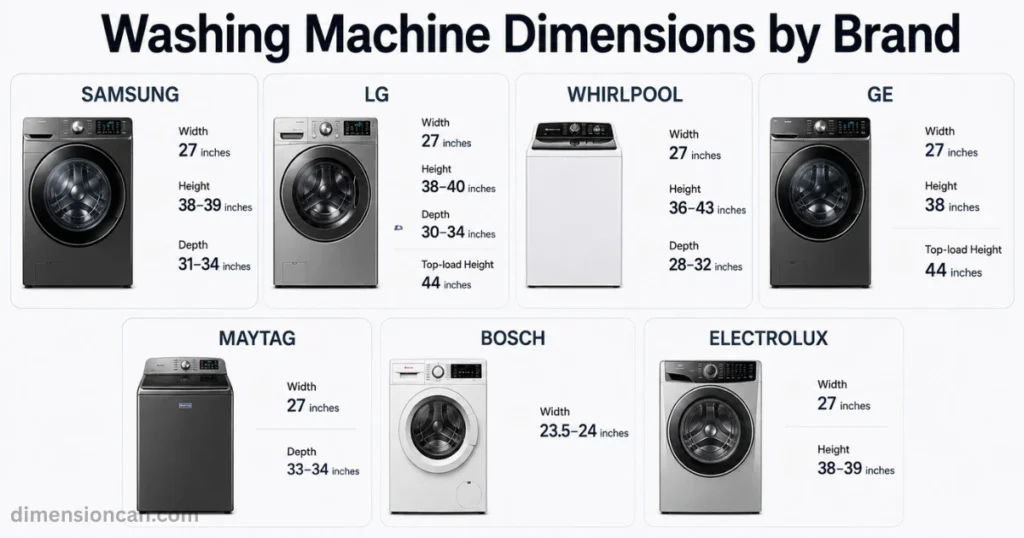
Samsung front-load washers generally measure around 27 inches wide and 38 to 39 inches tall, with depth ranging from 31 to 34 inches, depending on the model’s capacity.
LG Washing Machine Dimensions
LG’s front-load lineup typically sits at 27 inches wide, 38 to 40 inches tall, with a depth between 30 and 34 inches. Their top-load models tend to run slightly taller, closer to 44 inches.
Whirlpool Washing Machine Dimensions
Whirlpool washers, both top-load and front-load, generally fall within the 27-inch width standard, with heights between 36 and 43 inches and depths from 28 to 32 inches.
GE Washing Machine Dimensions
GE washing machines commonly measure 27 inches wide, with front-loaders averaging 38 inches tall and top-loaders closer to 44 inches.
Maytag Washing Machine Dimensions
Maytag’s washers, known for larger drum capacities, often run slightly deeper — around 33 to 34 inches — while keeping the standard 27-inch width.
Bosch Washing Machine Dimensions
Bosch front-load washers are known for a more compact footprint, often measuring closer to 23.5 to 24 inches wide, making them a strong option for smaller U.S. laundry rooms.
Electrolux Washing Machine Dimensions
Electrolux front-loaders typically measure 27 inches wide, 38 to 39 inches tall, with depths similar to Samsung and LG models.
Washing Machine Dimensions and Load Capacity
How Washing Machine Dimensions Affect Capacity
In the U.S., washer capacity is measured in cubic feet, not kilograms. A larger drum diameter and depth generally mean a higher cu. ft. rating.
Compact 24-inch washers usually offer 1.6 to 2.5 cu. ft., while standard 27-inch models range from 4.0 to 5.5 cu. ft., and large-capacity units can reach 5.5 to 6.0 cu. ft. or more.
Best Washing Machine Dimensions for Your Household Size
Here’s a simple way to match capacity to household size:
- 1 to 2 people: 3.0 to 4.0 cu. ft.
- 3 to 4 people: 4.0 to 4.5 cu. ft.
- 5 or more people: 4.5 to 6.0 cu. ft. or larger
Bigger households benefit from larger drums since they mean fewer loads per week — a real time-saver, though it also means a wider or deeper footprint to plan for.
More Posts:Kitchen Sink Sizes: Dimensions, Depth & Cabinet Fit
Washing Machine Dimensions for Special Installations
Stackable Washing Machine Dimensions
Stackable washers are almost always front-load models, since top-loaders can’t safely support a dryer above them.
When stacked with a matching dryer and stacking kit, the combined unit typically reaches 70 to 75 inches tall, while keeping the same 27-inch width as the individual machines.
Washer-Dryer Combo Dimensions
An all-in-one washer-dryer combo washes and dries in a single drum, which keeps its footprint close to a standard front-loader: about 24 to 27 inches wide, 33 to 39 inches tall, and 25 to 34 inches deep.
Built-In and Closet Installation Dimensions
For a built-in laundry closet, most codes and manufacturers recommend at least 1 to 2 inches of clearance on each side and behind the machine for ventilation and hose access.
A standard closet opening for a single washer is usually 30 to 36 inches wide to comfortably fit a 27-inch machine with clearance.
How to Measure Your Space for Washing Machine Dimensions
Step-by-Step Measuring Guide
- Measure the width, height, and depth of the available space.
- Add 6 inches to the depth for hoses, cords, and the door swing.
- Add 1 inch on each side for ventilation, especially with front-load models.
- Check the height clearance above the unit, especially for top-loaders or stacked units.
Doorway, Hallway, and Clearance Space to Check
A washer that fits your laundry room won’t help if it can’t make it through your front door. Measure doorway widths, hallway turns, and staircases the machine must pass through during delivery. Standard interior doors are 28 to 32 inches wide, which is often tighter than expected once you factor in the appliance’s depth.
FAQs About Washing Machine Dimensions
What is the standard size of a washing machine?
A standard washing machine is about 27 inches wide, 33 to 45 inches tall, and 28 to 34 inches deep, depending on whether it’s a front-load or top-load model.
How much space do I need around a washing machine?
Most manufacturers recommend at least 1 inch of clearance on each side and 6 inches behind the unit for hoses and ventilation.
What is the difference between front-load and top-load washer dimensions?
Front-load washers are shorter but deeper, while top-load washers are taller with less depth, mainly because of the lid-opening design.
Can I stack any washing machine with a dryer?
No. Only front-load washers are designed to be stacked safely with a dryer, using a manufacturer-approved stacking kit.
What size washing machine fits in a small apartment?
A 24-inch compact washer is the best fit for small apartments, offering roughly 1.6 to 2.5 cu. ft. capacity in a narrower footprint.

James Walker is a content researcher and writer specializing in dimensions, measurements, size comparisons, and conversion topics. He creates clear, practical, and easy-to-understand guides that help readers visualize and understand real-world measurements.