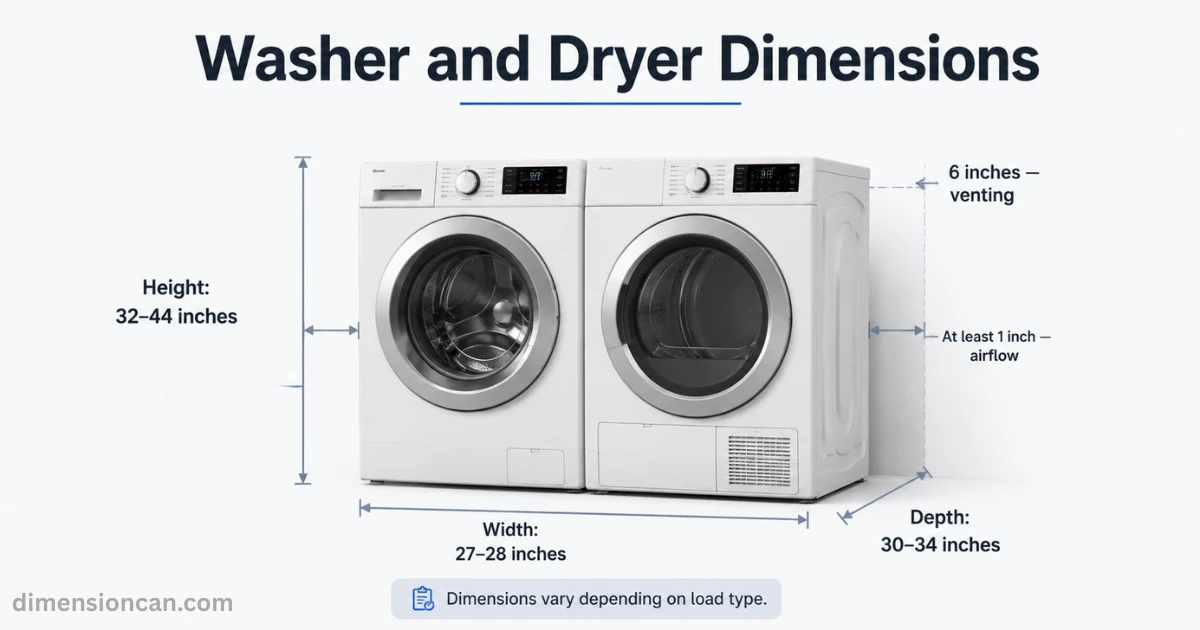
Most washers and dryers measure 27–28 inches wide, 32–44 inches tall, and 30–34 inches deep, depending on the load type. Allow 6 inches behind the unit for venting and at least 1 inch of clearance on each side for proper airflow.
There is no single standard washer and dryer size. Widths, heights, and depths shift by brand, load capacity, and washer type.
This guide breaks down real washer and dryer dimensions for every setup: front load, top load, stackable, compact, and brand by brand.
Standard Washer and Dryer Dimensions
Front Load Washer and Dryer Dimensions
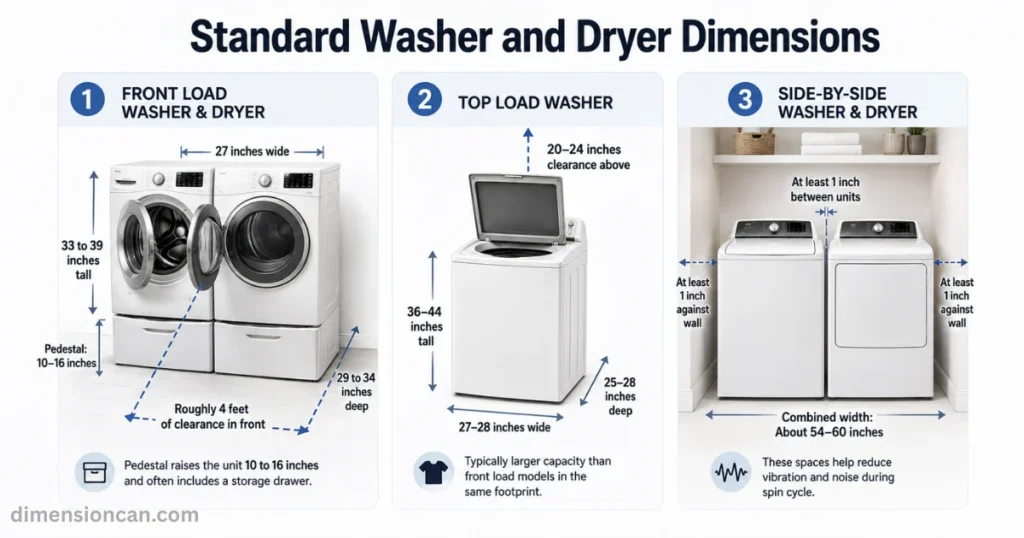
Front load washers and dryers typically run 27 inches wide, 33 to 39 inches tall, and 29 to 34 inches deep. Because the door swings outward, you’ll need roughly 4 feet of clearance in front of the unit for loading and unloading comfortably.
Front load machines sit lower to the ground than top load models. Many owners add a pedestal, which raises the unit 10 to 16 inches and often includes a storage drawer underneath.
Top Load Washer Dimensions
A typical top load washer measures 27 to 28 inches wide, 36 to 44 inches tall, and 25 to 28 inches deep. Because the lid opens upward, plan for 20 to 24 inches of clearance above the machine.
Top load washers tend to have a larger capacity than front load models in the same footprint.
Side-by-Side Washer and Dryer Dimensions
A side-by-side washer and dryer setup needs a combined width of about 54 to 60 inches. Each unit needs at least 1 inch of space between them and against the wall to cut down on vibration and noise during the spin cycle.
More Posts:Refrigerator Dimensions: A Complete Guide to Finding the Right Fit
Stackable Washer and Dryer Dimensions
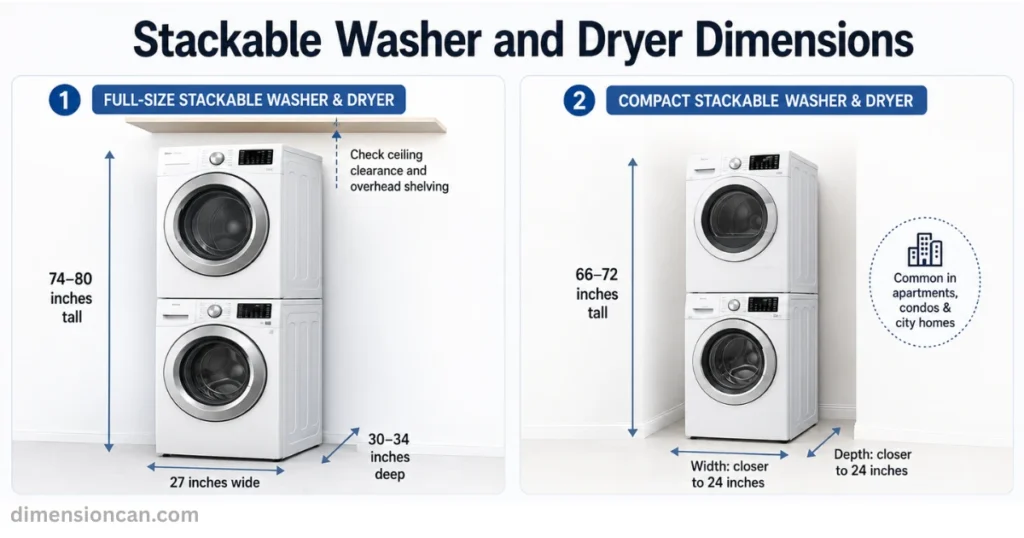
Stacking a front load washer under a matching dryer keeps the footprint to a single 27-inch-wide column.
A full-size stacked pair usually stands 74 to 80 inches tall and runs 30 to 34 inches deep. That height matters — measure your ceiling clearance and any overhead shelving before committing to a stacked setup.
Compact stackable units are shorter, at 66 to 72 inches tall, with a width and depth closer to 24 inches. These are common in apartments, condos, and city homes where every square foot counts.
Washer and Dryer Dimensions by Brand
Whirlpool Washer and Dryer Dimensions
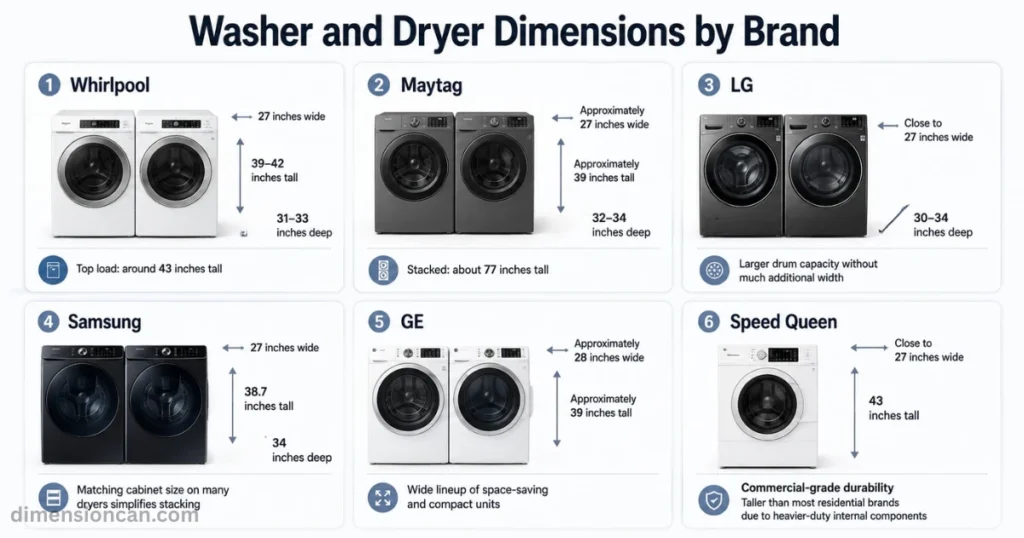
Whirlpool front load pairs generally measure 27 inches wide and 39 to 42 inches tall, with a depth near 31 to 33 inches. Whirlpool’s top load models run slightly taller, often near 43 inches.
Maytag Washer and Dryer Dimensions
Maytag front load washers and dryers measure close to 27 inches wide, 39 inches tall, and 32 to 34 inches deep. Maytag’s stacked pairs reach about 77 inches in height, matching the industry-wide stackable range.
LG Washer and Dryer Dimensions
LG front load units tend to run slightly deeper than competitors, often 30 to 34 inches deep, which gives them a larger drum capacity without adding much width. Standard width stays close to 27 inches.
Samsung Washer and Dryer Dimensions
Samsung front load washers commonly measure 27 inches wide, 38.7 inches tall, and 34 inches deep. Many Samsung dryers use a matching cabinet size, which simplifies stacking.
GE Washer and Dryer Dimensions
GE offers some of the more compact standard-size options, with front load models near 28 inches wide and 39 inches tall. GE also produces a wider lineup of space-saving and compact units than most competitors.
Speed Queen Washer and Dryer Dimensions
Speed Queen, known for commercial-grade durability, builds front load washers close to 27 inches wide and 43 inches tall — noticeably taller than most residential brands due to heavier-duty internal components.
More Posts:Tarot Card Dimensions – Mini, Pocket, Large & Jumbo
Compact and Apartment-Size Washer and Dryer Dimensions
Compact washer and dryer dimensions typically fall around 24 inches wide, 33 to 36 inches tall, and 22 to 26 inches deep. This size class is built for apartments, condos, dorms, and RVs where floor space is limited.
Washer-dryer combo units, which wash and dry in a single drum, measure close to 23 to 27 inches wide, 33 to 38 inches tall, and 20 to 25 inches deep. These are ventless machines, meaning they don’t need an exterior vent — a major advantage for apartment living.
Portable washers, the smallest category, run as narrow as 17 to 22 inches wide. They connect to a sink faucet and work well for small, infrequent loads.
Washer and Dryer Space and Clearance Requirements
Key clearance rules to follow:
- Leave 6 inches behind the unit for hoses and venting.
- Leave 1 inch on each side and between machines to reduce vibration.
- Allow 20 to 24 inches above or in front for full door or lid clearance.
- Measure every doorway, hallway, and turn along the delivery path before your machine arrives — width, not just floor space, determines whether it fits.
Washer and Dryer Dimensions FAQs
Are all washers and dryers 27 inches wide?
No. While 27 inches is the most common width, models range from 17 inches for portables to 30 inches for some large-capacity units.
What is the standard depth of a washer and dryer?
Most standard washers and dryers measure 30 to 34 inches deep, not counting the extra 6 inches needed behind the unit for hoses and venting.
How much space do you need behind a washer and dryer?
Plan for 6 inches of clearance behind the machine. This space allows room for the water hoses, drain line, and dryer vent to connect without kinking.
Do gas and electric dryers have different dimensions?
No. Gas and electric dryers from the same model line share identical width, height, and depth. The difference is in the hookup — gas dryers need a gas line and electric dryers need a 240-volt outlet.
What are the dimensions of a stackable washer and dryer?
A full-size stacked pair measures about 27 inches wide, 74 to 80 inches tall, and 30 to 34 inches deep. Compact stacked units run shorter, closer to 66 to 72 inches tall.
How do I know if a washer and dryer will fit through my door?
Measure your narrowest doorway, hallway turn, and stairwell jamb to jamb. Compare that number to the washer’s width plus a few inches of wiggle room — most standard doorways handle a 27-inch-wide machine, but tight turns can still block delivery.
Conclusion
Washer and dryer dimensions aren’t one-size-fits-all. Front load, top load, stackable, and compact units all carry different width, height, and depth ranges — and even brands like Whirlpool, Maytag, LG, Samsung, GE, and Speed Queen vary by a few inches on otherwise similar models.

James Walker is a content researcher and writer specializing in dimensions, measurements, size comparisons, and conversion topics. He creates clear, practical, and easy-to-understand guides that help readers visualize and understand real-world measurements.