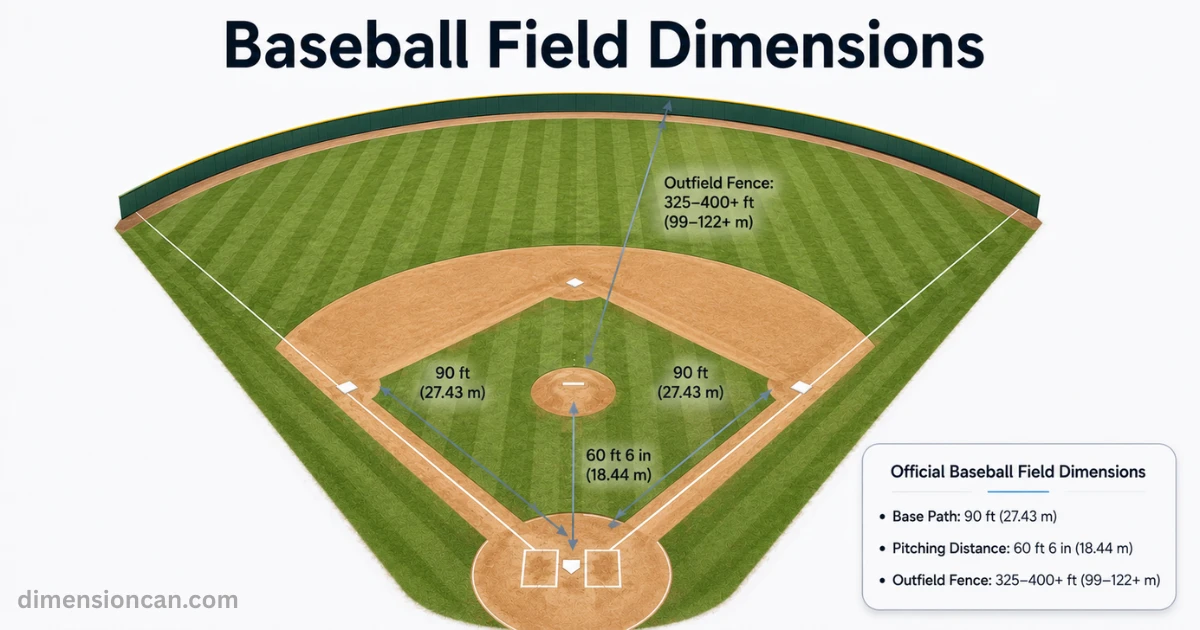
Every measurement on a baseball diamond, from the base paths to the outfield fence, is built around player safety and fair competition.
This guide breaks down the exact baseball field size for every age group, plus the layout details most guides skip entirely.
Baseball Field Dimensions by Age and League Level
T-Ball and Coach Pitch Field Dimensions (Ages 4–7)
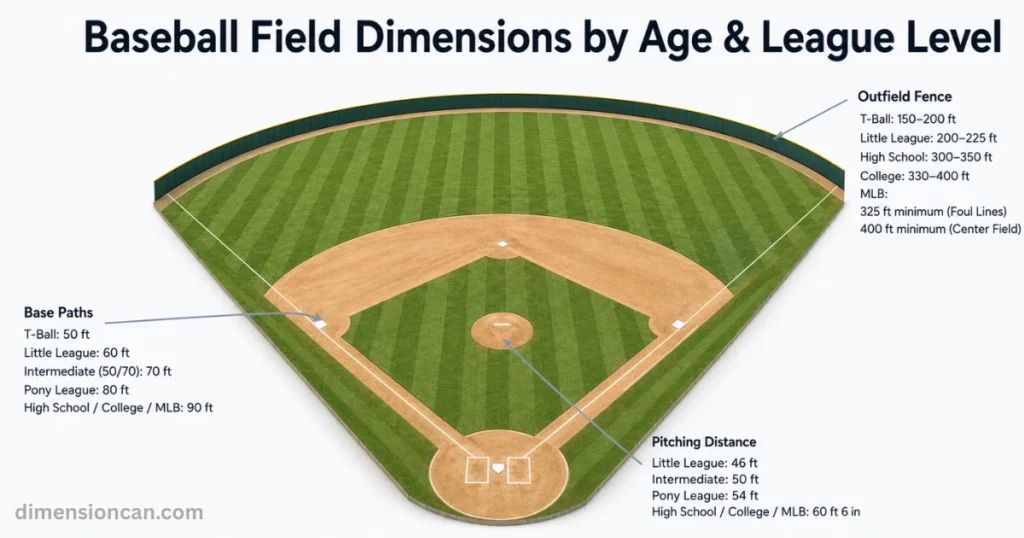
T-ball fields use 50-foot base paths. There is no pitching distance to speak of since a tee or a coach delivers the ball. Outfield fences sit close, usually between 150 and 200 feet, since young hitters cannot drive the ball far.
Little League Baseball Field Dimensions (Ages 9–12)
Little League baseball field dimensions call for 60-foot base paths and a 46-foot pitching distance. This scaled-down diamond protects growing arms while still teaching real game mechanics. Fences typically run 200 to 225 feet.
Intermediate and Pony League Field Dimensions (Ages 11–14)
The 50/70 division bridges Little League and full-size play, using 50-foot pitching distance with 70-foot base paths. Pony League pushes further, with 80-foot base paths and a 54-foot pitching distance for ages 13 and 14.
High School Baseball Field Dimensions
High school baseball field dimensions match the professional standard: 90-foot base paths and a 60-foot 6-inch pitching distance. Fences generally sit between 300 and 350 feet, giving hitters more room to work with than youth levels.
College Baseball Field Dimensions
NCAA baseball field dimensions mirror high school infield specs but often extend outfield fences to 330 to 400 feet, depending on the ballpark’s design and available land.
MLB Baseball Field Dimensions
MLB baseball field dimensions are the gold standard. Major League Baseball requires 90-foot base paths, a 60-foot 6-inch pitching distance, and a center field fence of at least 400 feet, with 325 feet minimum down the foul lines. Every ballpark meets these floors, though many exceed them by a wide margin.
Baseball Field Dimensions: Infield Layout and Key Components
Base Path Distances and the 90-Foot Diamond
A regulation baseball diamond measures 90 feet between each base. That distance is measured from the back tip of home plate to the far corner of first and third base, forming a perfect square when viewed from above. The straight-line distance from home plate to second base works out to 127 feet 3⅜ inches.
Pitching Distance and Pitcher’s Mound Dimensions
The pitcher’s mound sits 60 feet 6 inches from home plate at the professional and high school level. The mound itself forms an 18-foot diameter circle, rising 10 inches above the playing field. This small hill gives pitchers leverage and a slight downward angle on every pitch.
Home Plate and Batter’s Box Measurements
Home plate is a five-sided slab of rubber, 17 inches wide across the front edge with two 8.5-inch sides and a pointed back that extends 12 inches. On either side sit the batter’s boxes, each measuring 4 feet by 6 feet, positioned 6 inches from the plate.
Infield Arc, Skin, and Grass Line Dimensions
The infield arc, also called the skin, is the dirt area surrounding the mound and bases. In MLB, this arc typically extends 95 feet from the pitching rubber. The line where dirt meets grass, known as the grass line, varies slightly by ballpark but generally follows this same radius.
Why the Pitching Distance Is 60 Feet 6 Inches
This oddly specific number traces back to 1893, when officials moved pitchers back from 50 feet to reduce their dominance over hitters. A popular theory says a surveyor’s notation of “60-0”, meaning 60 feet even, was misread as 60 feet 6 inches. Whatever the true origin, the distance has stood unchanged for over 130 years.
Baseball Field Dimensions: Outfield, Fences, and Foul Territory
Outfield Fence Distance Standards by Level
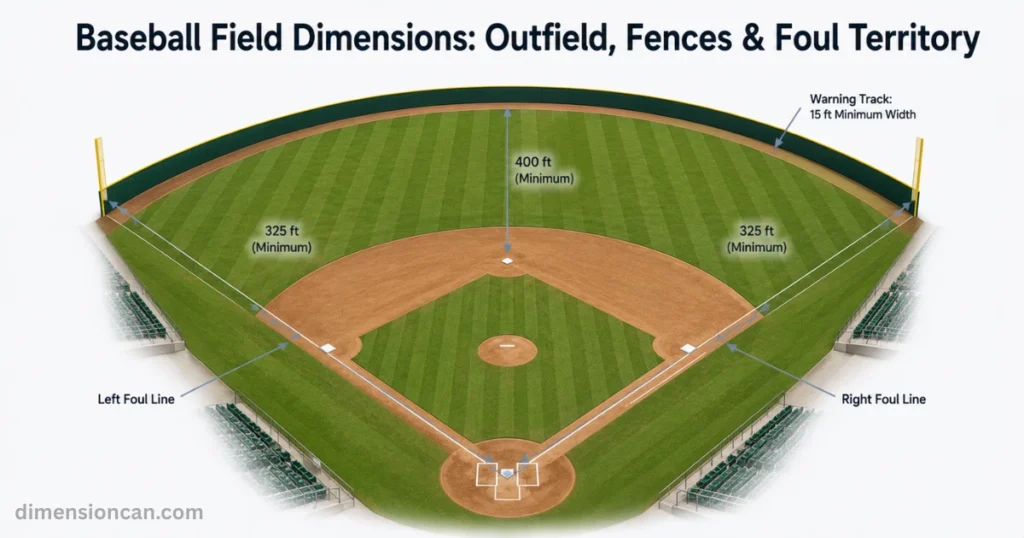
Outfield fence distances grow with each level of play. Youth leagues start around 200 feet, high school fields require 300 to 325 feet, and MLB parks must reach 400 feet to center field and 325 feet down the lines at minimum.
Foul Lines and Foul Territory Dimensions
Foul lines stretch from home plate through first and third base out to the outfield fence, marking the boundary of fair play. Foul territory, the space between the foul lines and the stands, varies dramatically by stadium. Some parks have generous foul ground that turns fly balls into outs, while others hug the field tightly, keeping fans close to the action.
Warning Track Width and Placement
A warning track runs along the inside edge of the outfield fence, extending at least 15 feet into the field. Its surface, usually crushed brick or fine gravel, feels different underfoot than grass. This subtle change alerts outfielders that the fence is close, helping them avoid full-speed collisions.
Why MLB Outfield Dimensions Vary by Stadium
Unlike the infield, which is fixed everywhere, MLB outfield dimensions are only bound by minimums. Teams design fences around available land, city blocks, and even strategy. Fenway Park’s Green Monster sits just 310 feet down the left field line, while other parks stretch beyond 420 feet to center. This variety is one of baseball’s defining quirks.
Baseball Field Construction Standards and Orientation
Correct Baseball Field Orientation
Regulation guidance recommends home plate face roughly east-northeast toward second base. This orientation keeps the setting sun out of a batter’s eyes during evening games and reduces glare for both hitters and fielders during late-inning play.
Infield Mix, Turf, and Drainage Requirements
The infield skin uses a blended mix of clay, sand, and silt, engineered for firm footing and quick drainage after rain. Grass areas require a slight slope, often 0.5 to 1 percent, directing water away from the playing surface and toward drainage points around the field’s edge.
Backstop Height and Distance Standards
The backstop sits behind home plate, positioned 25 feet away at youth levels and up to 60 feet or more in professional stadiums. Height requirements typically call for 20 to 30 feet of netting or fencing, protecting fans from foul balls that sail straight back.
Fencing, Netting, and Spectator Safety Zones
Beyond the backstop, many fields extend protective netting along both baselines. This addition has become increasingly common at every level after growing awareness of foul ball injuries among spectators sitting close to the field.
Baseball Field Dimensions: Dugouts, Bullpens, and Supporting Areas
Baseball field dimensions extend well past the diamond itself. These supporting spaces matter just as much for a functional, regulation-ready field.
Dugout Size and Placement Standards
Dugouts typically run 50 to 75 feet long and sit below or level with the field, positioned along the foul lines past first and third base. Standard depth allows a full roster plus coaching staff to sit comfortably while keeping sightlines open to the field.
Bullpen Dimensions and Mound Specifications
Bullpens house warm-up mounds for relief pitchers. Each mound matches the game mound exactly, an 18-foot diameter with 10-inch elevation, positioned 60 feet 6 inches from a marked plate. Most bullpens include space for two mounds side by side, letting two pitchers warm up at once.
On-Deck Circle Measurements
The on-deck circle is a simple ring, 5 feet in diameter, located in foul territory near each dugout. This is where the next batter takes practice swings while waiting for their turn at the plate.
Coach’s Box Dimensions
Coach’s boxes sit near first and third base, each measuring 6 feet by 10 feet. Base coaches must stay inside these lines during live play, a rule that keeps the field organized and prevents interference with fielders.
FAQ’s About Baseball Field Dimensions
Are all bases 90 feet apart on a baseball field?
No. Only high school, college, and professional fields use the full 90-foot base paths. Youth levels use shorter distances, ranging from 50 to 80 feet, based on age.
What is the standard size of a baseball field?
The most common standard baseball field has 90-foot base paths, a 60-foot 6-inch pitching distance, and outfield fences between 325 and 400 feet.
Why is the pitching distance 60 feet 6 inches?
This distance dates back to 1893, when the pitching rubber moved back from 50 feet. A likely surveying error turned “60 feet even” into the permanent 60’6″ standard still used today.
What is the minimum distance to the outfield fence?
Minimums depend on the level. Little League requires 200 feet, high school needs 300 to 325 feet, and MLB mandates 400 feet to center with 325 feet down the lines.
Are all baseball outfield dimensions the same size?
No. While infield measurements stay fixed for a given level, outfield fences vary by stadium. MLB parks range from roughly 302 feet to over 435 feet at their deepest point.
How big is a regulation baseball?
A regulation baseball measures 9 to 9.25 inches in circumference and weighs 5 to 5.25 ounces, wrapped in leather and joined by 108 red stitches.
Is a 400-foot home run considered long?
Yes. Roughly 15 to 20 percent of MLB home runs travel 400 feet or more. Anything past 450 feet ranks among the game’s rare, standout power shots.
Conclusion
Baseball field dimensions shift with every age group, but the purpose behind each number stays the same: protect players and keep the game fair. Whether you are building a Little League diamond or studying an MLB ballpark, these measurements are the blueprint behind every pitch, swing, and play.

James Walker is a content researcher and writer specializing in dimensions, measurements, size comparisons, and conversion topics. He creates clear, practical, and easy-to-understand guides that help readers visualize and understand real-world measurements.