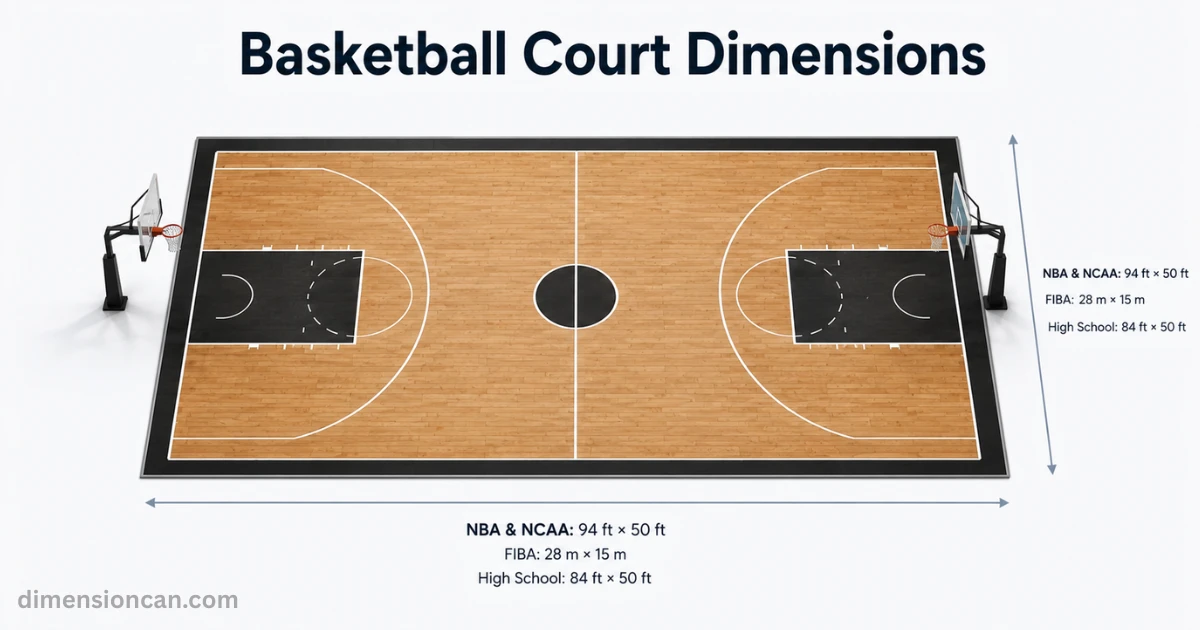
Basketball court size is not one-size-fits-all. Whether you’re a coach, a parent building a home court, or a facility planner, knowing the right court measurements helps you build, coach, and play smarter.
This guide breaks down every official size, every key marking, and the practical planning details most guides skip — like cost, orientation, and small-space layouts.
Basketball Court Dimensions by Level (NBA, NCAA, High School & More)
NBA & Professional Court Dimensions
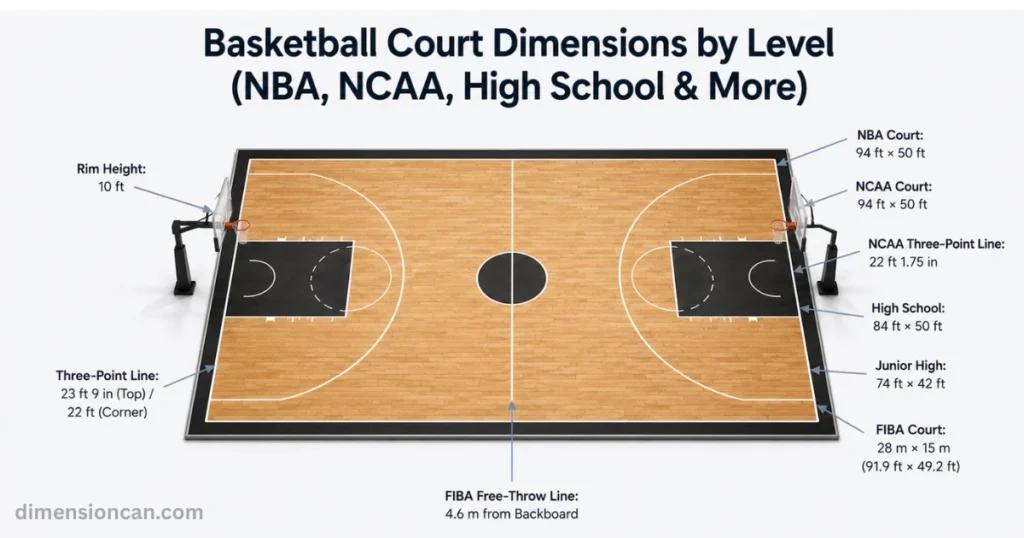
An NBA court measures 94 feet long and 50 feet wide, creating a total playing surface of 4,700 square feet. The rim sits 10 feet high. The three-point line sits 23 feet 9 inches from the basket at the top, shrinking to 22 feet in the corners. NBA arenas use hardwood maple flooring, chosen for consistent ball bounce and long-term durability.
NCAA College Court Dimensions
College basketball courts match the NBA at 94 feet by 50 feet. The main difference is the three-point arc, positioned closer at 22 feet 1.75 inches. This shorter distance encourages more perimeter shooting and shifts offensive strategy compared to the pros.
High School & Junior High Court Dimensions
A high school basketball court measures 84 feet by 50 feet, following NFHS guidelines. That’s 10 feet shorter than an NBA court but the same width. Junior high courts shrink further to 74 feet by 42 feet, sized for younger athletes still building strength and stamina.
FIBA International Court Dimensions
FIBA courts, used in the Olympics and most countries outside the U.S., measure 28 meters by 15 meters — roughly 91.9 feet by 49.2 feet. That makes FIBA courts slightly smaller than NBA courts. The free-throw line sits 4.6 meters from the backboard, a touch farther than the American 15-foot standard.
More Posts:Ping Pong Table Dimensions: The Complete Size & Space Guide
Basketball Court Markings and Key Areas Explained
Court markings aren’t random. Every line has a purpose — guiding inbound plays, shot distances, and violations like the three-second rule.
Three-Point Line Distances by Level
The three-point line varies more than any other marking. NBA shooters face a 23’9″ arc, NCAA and FIBA players shoot from 22’1.75″, and high schoolers shoot from just 19’9″. This distance shapes shooting mechanics and strategy at every level.
Free-Throw Line and Key (Paint) Dimensions
The free-throw line stays fixed at 15 feet from the backboard across nearly every American level. The key, also called the paint, measures 16 feet wide in the NBA and high school, though some youth leagues narrow it to 12 feet.
Center Circle and Restricted Arc
The center circle has a 12-foot diameter in the NBA, used for jump balls. High school and FIBA courts use a slightly smaller 11.81-foot circle. Under the basket, a 4-foot restricted arc stops defenders from drawing charging fouls too close to the rim.
Line Width, Color and Court Markings Standards
Every boundary line, from the sideline to the baseline, measures 2 inches wide and appears in a contrasting color for visibility. This consistency helps referees make fast, accurate calls during live play.
Basketball Hoop, Rim and Backboard Dimensions
The hoop is where every possession ends, so its dimensions stay tightly standardized across levels.
Rim Height and Diameter
The rim sits exactly 10 feet above the floor for players aged 12 and up. The rim has an 18-inch diameter and extends 6 inches out from the backboard face.
Backboard Size (Regulation vs Adjustable)
A regulation backboard measures 72 inches wide by 42 inches tall, with a smaller inner rectangle — 24 by 18 inches — used for bank shots. Backyard hoops often use adjustable backboards, letting families lower the rim for younger kids.
Net Length and Mounting Specs
Nets hang 15 to 18 inches long. Indoor courts favor white nylon nets, while outdoor courts often switch to chain nets that hold up better against wind and rain.
More Posts:Tennis Court Dimensions: The Complete Size Guide (2026)
How to Plan a Basketball Court for Your Home or Backyard
Building a home court takes more planning than most people expect. Space, surface, and layout all affect playability.
Full Court vs. Half Court Space Requirements
A full court needs 94 by 50 feet plus safety clearance, pushing the real footprint closer to 104 by 60 feet. A half court, at roughly 47 by 50 feet, fits far more backyards and still allows real gameplay.
Driveway and Small-Space Court Sizing
Most driveway courts range from 20 by 30 feet to 30 by 50 feet. A 30 by 30 foot space (900 square feet) works fine for shooting drills but feels tight for actual games. For real half-court play, aim for at least 40 by 50 feet.
Best Surface Materials and Cost
Concrete and asphalt are the most common outdoor surfaces because they resist weather and last for years. Modular sports tiles cost more upfront but improve ball response and reduce joint strain. Outdoor court costs typically scale with size, material grade, and site prep needs — always get a local quote before budgeting.
Court Orientation and Sun/Glare Placement Tips
Few guides mention this, but court orientation matters. A north-south layout reduces direct sun glare in shooters’ eyes during peak daylight hours, which matters most for outdoor courts used in the afternoon.
Safety Clearance and Run-Off Space
Always add run-off space around the playing lines — a minimum of 5 feet for casual play, more for competitive setups. This buffer prevents collisions with fences, walls, or parked cars near the court.
FAQs
What is a standard basketball court with dimensions?
A standard full-size court measures 94 feet by 50 feet in professional and college play. The rim sits 10 feet high, and the free-throw line stays 15 feet from the backboard.
What are the dimensions of a high school basketball court?
A high school court measures 84 feet by 50 feet, creating a 4,200 square foot playing area — 10 feet shorter than NBA courts.
Is 30×30 feet big enough for a basketball court?
A 30×30 foot space works for shooting drills and one-on-one play but is too small for a full game. Aim for 40 by 50 feet for better gameplay.
What is a good size for an outdoor basketball court?
An ideal outdoor court measures at least 40 by 50 feet. Full courts need 94 by 50 feet plus safety clearance on all sides.
What size is a high school basketball hoop?
High school hoops match professional specs — an 18-inch rim mounted 10 feet high, with a 72 by 42 inch backboard.
How much does it cost to build a basketball court?
Cost depends on size, surface type, and location. Concrete and asphalt tend to cost less than modular tile systems, but get a local contractor quote for accurate pricing.
What’s the difference between an NBA court and a FIBA court?
An NBA court measures 94 by 50 feet, while a FIBA court measures 28 by 15 meters (about 91.9 by 49.2 feet) — slightly smaller overall.

James Walker is a content researcher and writer specializing in dimensions, measurements, size comparisons, and conversion topics. He creates clear, practical, and easy-to-understand guides that help readers visualize and understand real-world measurements.