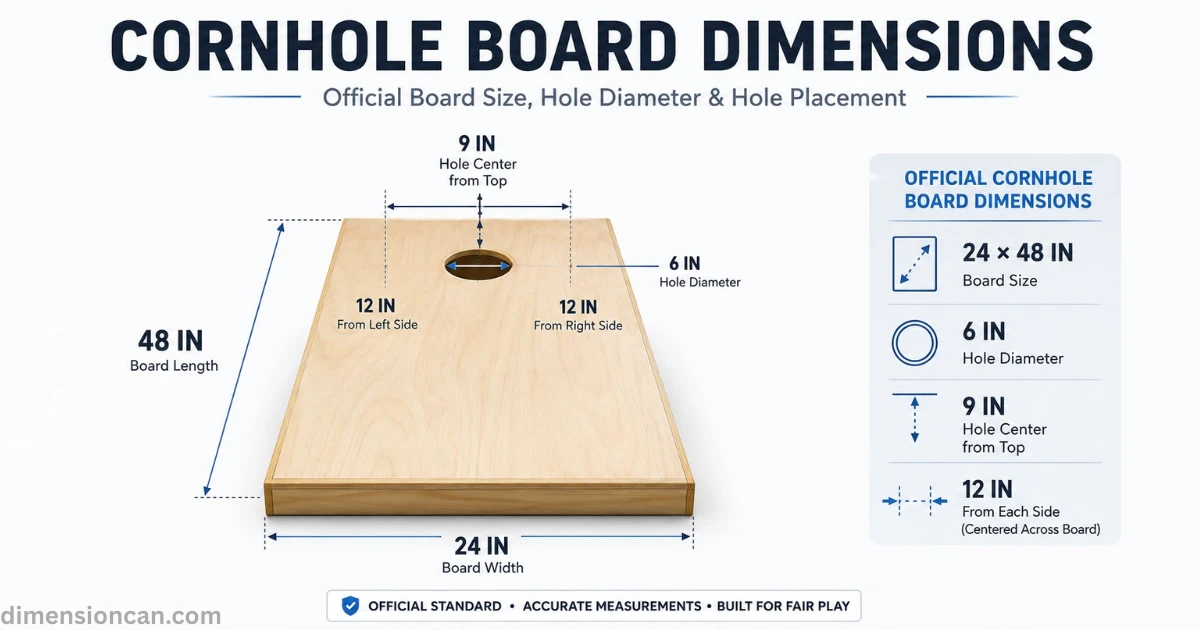
Official cornhole board dimensions are 24 × 48 inches, with a 6-inch hole centered 9 inches from the top and 12 inches from each side. These regulation specifications ensure consistent gameplay and are the standard for ACA and ACL tournament play.
This guide breaks down every cornhole board dimension that matters: board size, hole placement, board height, playing distance, and how each one changes your game.
Official Cornhole Board Dimensions
Regulation Board Length and Width
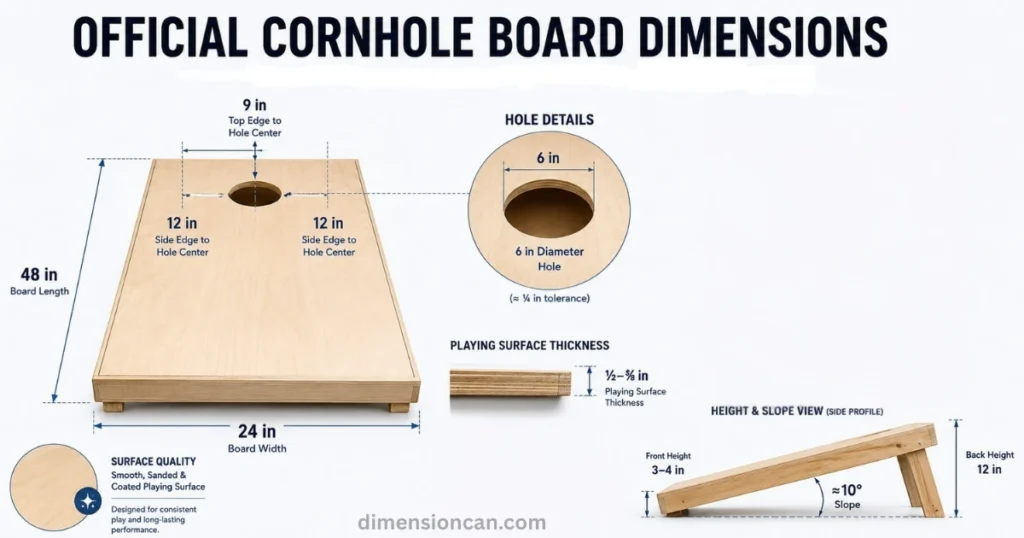
A regulation board measures 48 inches long and 24 inches wide — often written as 2×4 boards in the industry. Some official tolerances allow a small range, roughly 23½ to 24 inches wide and 47½ to 48 inches long.
Board Thickness and Surface Requirements
The playing surface should be ½ inch to ⅝ inch thick, usually made from plywood. Thinner boards flex and warp. Thicker boards get heavy and hard to haul around. This range is the sweet spot between durability and portability.
The surface also has to be smooth. Any bump, ridge, or rough patch changes how a bag slides, which is why tournament boards get sanded and coated, not just painted.
Hole Diameter and Placement Dimensions
The hole is 6 inches in diameter, with a tolerance of about ¼ inch:
- 9 inches from the top edge of the board to the center of the hole
- 12 inches from each side of the board to the center of the hole
That puts the hole dead-center, side to side, and close enough to the top edge that a well-thrown bag has real room to slide into it.
Front and Back Board Height
A regulation board sits at 3 to 4 inches tall in the front and 12 inches tall in the back. That height difference creates the board’s slope — roughly a 10-degree angle — which is what gives cornhole bags their signature slide instead of a flat bounce.
More Posts:Pallet Dimensions by Type, Region & Load Capacity
Cornhole Board Distance and Court Setup Dimensions
Pitcher’s Box-to-Box Distance
Regulation play sets the boards 27 feet apart, measured from the front edge of one board to the front edge of the other. This is the number most backyard players get wrong, either guessing or measuring from the wrong edge.
Foul Line and Pitching Area Dimensions
Players throw from behind the front edge of the board, which doubles as the foul line. Standing past that line while releasing a bag counts as a foul in tournament rules.
Total Space Needed in a Backyard or Garage
27 feet between boards, plus 4 feet of board length on each side, plus a few feet of clearance behind each board for the backswing and follow-through.
In real terms, plan for a space roughly 38 to 45 feet long and 6 to 8 feet wide. That’s bigger than most people picture before they measure it out.
Cornhole Board Size Chart – Regulation vs. Backyard vs. Mini
Regulation (Tournament) Size
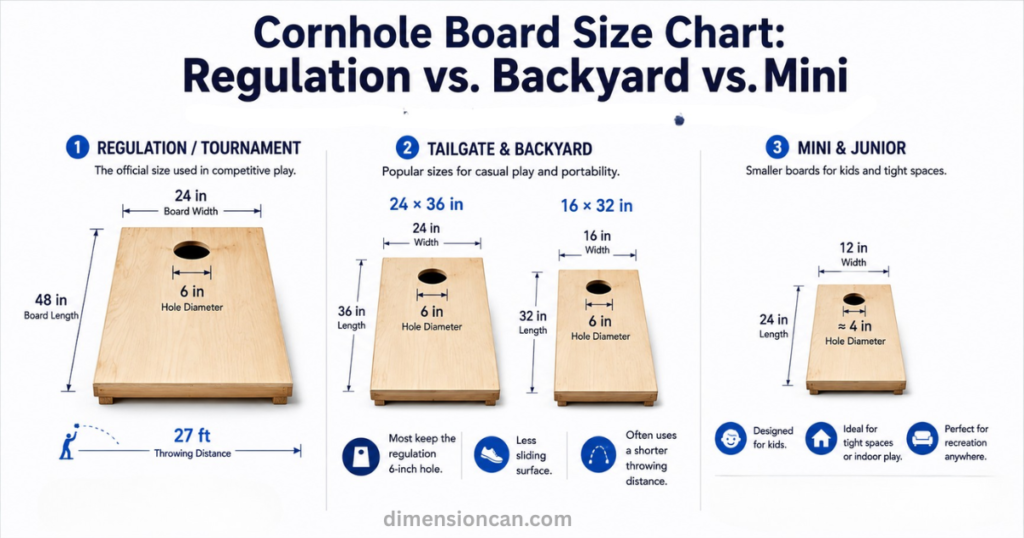
24 x 48 inches, 6-inch hole, played at 27 feet. This is the only size accepted in ACA and ACL sanctioned events.
Tailgate and Backyard Size
Common backyard and tailgate boards run 24 x 36 inches, with some slimmer versions at 16 x 32 inches. Most keep the regulation 6-inch hole, so the target still feels familiar — you’re just working with less sliding surface and, often, a shorter throwing distance.
Mini and Junior Board Dimensions
Mini boards typically measure 12 x 24 inches, scaled down with a smaller hole around 4 inches in diameter. These are built for kids, tight spaces, or indoor play — not for practicing tournament accuracy, since the shrunk-down proportions change the throw entirely.
Building Boards to Regulation Cornhole Dimensions
Materials That Meet Regulation Standards
Most builders use ½-inch plywood for the top and 2×4 lumber for the frame, matching the thickness range set by the ACA. Baltic birch is a popular upgrade for tournament-grade boards because it resists warping better than standard plywood.
Cutting Guide for Accurate Board Dimensions
Cut the frame first, then measure the actual frame — not a pre-set number — before cutting the plywood top to fit. This avoids the common mistake of a top that’s slightly too big or small for the frame underneath. Mark the hole’s center point using the 9-inch and 12-inch measurements before drilling a pilot hole and cutting with a jigsaw.
Common Sizing Mistakes When Building Your Own
The most frequent errors: drilling the hole off-center, cutting board height without accounting for leg angle, and using plywood thinner than ½ inch, which flexes and warps within a season. Double-checking each measurement against the regulation chart before cutting saves a rebuild.
More Posts:Banner Dimensions Guide : YouTube, LinkedIn & Twitter Banner Dimensions Explained
FAQ’s About Cornhole Board Dimensions
What are the official cornhole board dimensions?
Regulation boards measure 24 inches wide by 48 inches long, with a 6-inch hole centered 9 inches from the top and 12 inches from each side.
How far apart should cornhole boards be?
Boards are set 27 feet apart, measured from the front edge of one board to the front edge of the other.
What size hole is regulation for a cornhole board?
The hole is 6 inches in diameter, with a tolerance of about ¼ inch.
How thick should a cornhole board be?
Regulation boards use a playing surface ½ inch to ⅝ inch thick, typically plywood.
Are all cornhole boards the same size?
No. Only tournament-sanctioned boards must be 24 x 48 inches. Backyard, tailgate, and mini boards come in smaller sizes for casual play.
What’s the standard height of a cornhole board?
The front sits 3 to 4 inches off the ground, while the back sits 12 inches high, creating the board’s slope.

James Walker is a content researcher and writer specializing in dimensions, measurements, size comparisons, and conversion topics. He creates clear, practical, and easy-to-understand guides that help readers visualize and understand real-world measurements.