A standard shipping container comes in three main lengths: 10 feet, 20 feet, and 40 feet, all about 8 feet wide. Height is available in two options: 8 feet 6 inches (standard) or 9 feet 6 inches (high cube).
This guide gives you the exact numbers so you can spec the right unit the first time.
Standard Shipping Container Dimensions (10ft, 20ft, 40ft)
10-Foot Shipping Container Dimensions
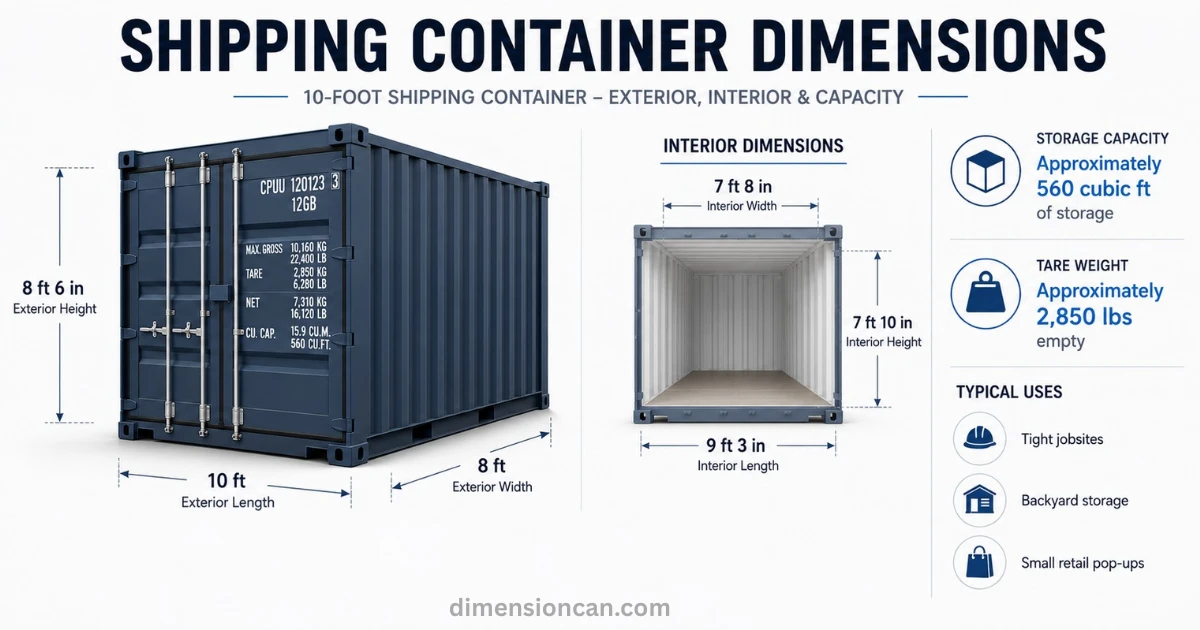
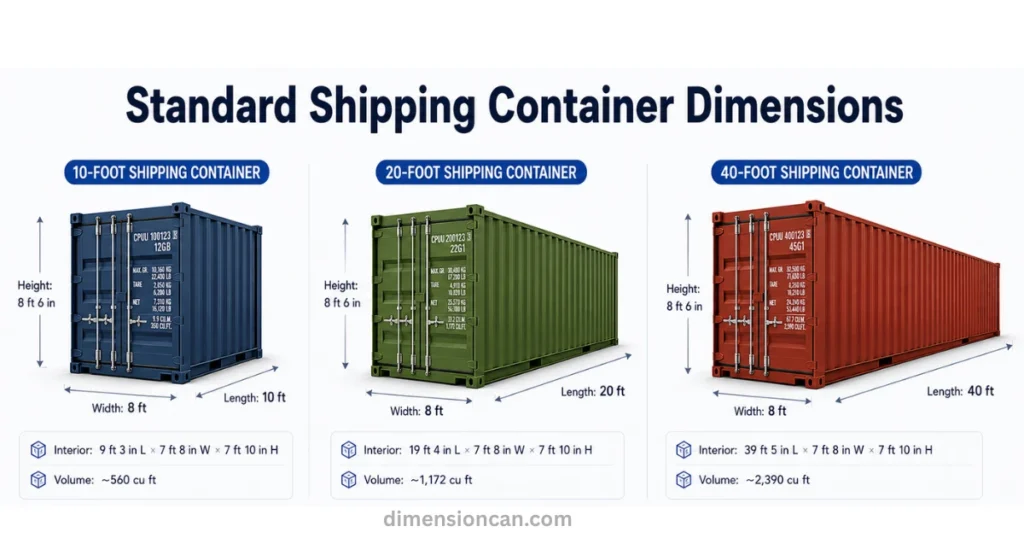
The 10ft container is the smallest widely available size. Exterior dimensions run about 10ft long, 8ft wide, and 8ft 6in tall. Inside, you get roughly 9ft 3in of length, 7ft 8in of width, and 7ft 10in of height, which works out to around 560 cubic feet of storage.
Tare weight sits near 2,850 lbs empty. This size suits tight jobsites, backyard storage, and small retail pop-ups where a full 20ft footprint won’t fit.
20-Foot Shipping Container Dimensions
The 20ft container is the industry’s benchmark size.
Exterior measurements run 20ft long, 8ft wide, and 8ft 6in tall. Interior space comes in at roughly 19ft 4in long, 7ft 8in wide, and 7ft 10in tall, giving you about 1,172 cubic feet and 150 square feet of floor space. Tare weight lands around 4,500 to 5,000 lbs depending on the manufacturer, and maximum payload typically tops 47,000 lbs.
The door opening measures about 7ft 8in wide by 7ft 5in tall. That number matters more than people expect. Forklifts, pallet jacks, and any tall equipment need to clear the door, not just the interior ceiling.
40-Foot Shipping Container Dimensions
The 40ft container doubles the length of a 20-footer while keeping the same width and height. Exterior dimensions are 40ft long, 8ft wide, and 8ft 6in tall. Interior space runs close to 39ft 5in long, 7ft 8in wide, and 7ft 10in tall, which adds up to around 2,390 cubic feet and 300 square feet of floor space.
Tare weight averages 8,000 to 8,500 lbs, with payload capacity often exceeding 61,000 lbs. Because a 40ft unit typically costs only around 30% more than a 20ft unit despite offering double the space, it’s usually the better value once your cargo or project outgrows a 20-footer.
More Posts:Washing Machine Dimensions by Type & Brand: LG, Samsung & More
High Cube Shipping Container Dimensions (40ft, 45ft, 53ft)
40-Foot High Cube Container Dimensions
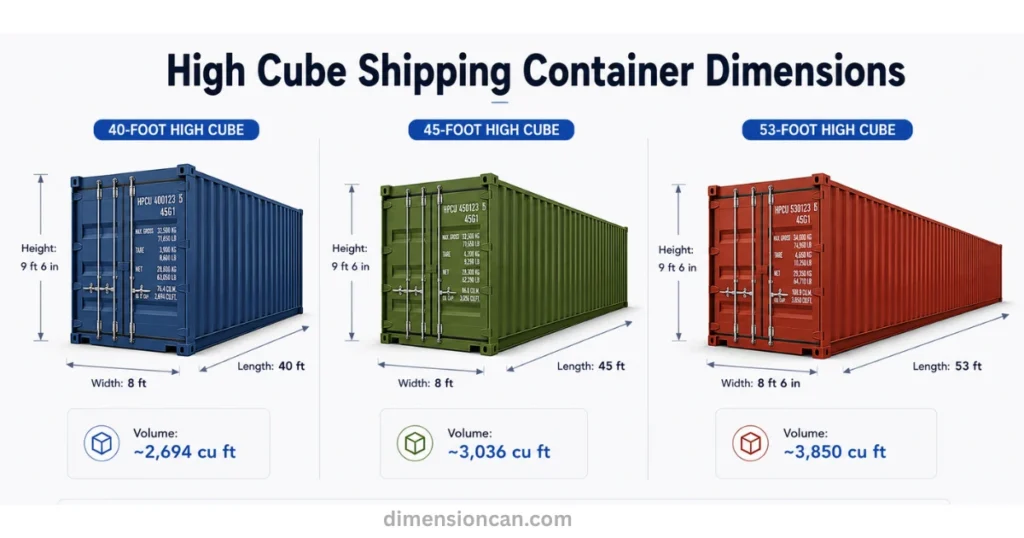
A 40ft high cube keeps the 40ft length and 8ft width of a standard unit but stands 9ft 6in tall outside. Interior height climbs to roughly 8ft 10in, pushing usable volume up to around 2,694 cubic feet, about 300 cubic feet more than the standard 40-footer.
This extra headroom matters for anyone stacking pallets two-high, running HVAC ductwork through a converted container, or needing standing clearance for tall machinery.
45-Foot High Cube Container Dimensions
The 45ft high cube stretches length even further while keeping the 9ft 6in height.
Interior dimensions run close to 44ft 5in long, 7ft 8in wide, and 8ft 9in tall, for roughly 3,036 cubic feet of capacity.
Few container guides cover this size in detail, which is a gap worth knowing about if you’re moving large machinery or bulky industrial components that need extra length, not just extra height.
53-Foot High Cube Container Dimensions
The 53ft high cube is the largest common size, and it breaks from the standard 8ft width, measuring closer to 8ft 6in wide to meet North American rail standards. Interior capacity reaches nearly 3,850 cubic feet, with payload capacity often topping 72,000 lbs.
Specialty Shipping Container Dimensions (Reefer, Open Top, Flat Rack, Double-Door)
Refrigerated (Reefer) Container Dimensions
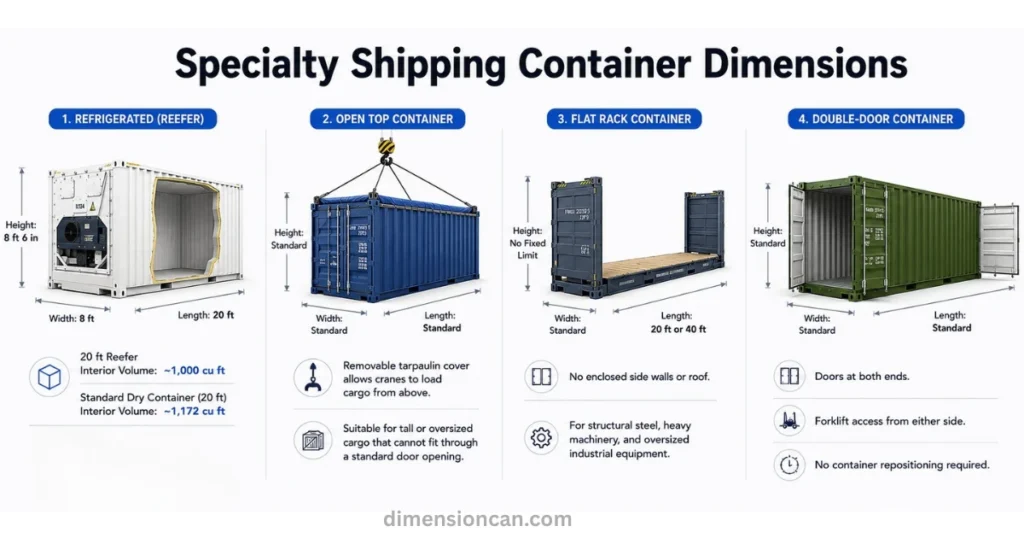
Reefer containers share the same 20ft and 40ft exterior footprints as standard units, but thicker insulated walls shrink interior space.
A 20ft reefer typically holds about 1,000 cubic feet inside, compared to 1,172 in a standard dry unit, because insulation panels eat into the width and height.
Open Top Container Dimensions
An open top container matches standard exterior dimensions but replaces the solid steel roof with a removable tarpaulin cover.
This lets cranes load cargo from above instead of through the door, which matters for tall or oversized items that won’t fit through a standard door opening.
Flat Rack Container Dimensions
Flat rack containers strip away the side walls and roof entirely, leaving just a floor and two end walls, which fold down on collapsible models. Length and width match standard 20ft or 40ft units, but there’s no fixed height limit since cargo isn’t boxed in.
This makes flat racks the go-to choice for structural steel, heavy machinery, and oversized industrial equipment that simply won’t fit through a standard door.
Double-Door Container Dimensions
A double-door container has the same exterior and interior dimensions as a standard unit, but adds a second set of swing doors at the opposite end. That second opening eliminates the dead zone at the back wall and lets forklifts load from either side without repositioning the container.
This design shows up often in construction sites and retail distribution, where faster loading and unloading directly saves labor hours.
More Posts:California King Bed Dimensions: Size, Area & Room Guide
Standard vs. High Cube Container Dimensions
| Feature | Standard Container | High Cube Container |
|---|---|---|
| Interior Height | 7 ft 10 in (2.39 m) | 8 ft 10 in (2.69 m) |
| Interior Volume | Standard cargo capacity | About 300 cubic feet more usable space on a 40 ft container |
| Payload Capacity | Standard payload for its size | Generally higher payload capacity due to a reinforced frame |
| Best For | Cargo under 7 ft tall, lower tare weight, easier stacking with standard containers | Tall cargo, double-stacked pallets, large machinery, container homes, and office conversions |
| Main Advantage | Lower weight and compatibility with standard container stacks | Extra headroom and greater storage volume without increasing the ground footprint |
How to Choose the Right Shipping Container Size
- Choose the right storage container based on your needs—20ft containers suit most home and small business storage, while 40ft containers handle larger inventories and equipment.
- Use 40ft or high cube containers for homes and office conversions, as the extra length and interior height create more usable living space. Always check local building codes before construction.
- For freight and shipping, 20ft and 40ft standard containers are the global standard, while open top and flat rack containers are designed for oversized or irregular cargo.
Shipping Container Dimensions FAQ
What are the exact interior dimensions of a 20-foot shipping container?
A 20ft container measures about 19ft 4in long, 7ft 8in wide, and 7ft 10in tall inside, giving you roughly 1,172 cubic feet of space.
How much does a 40-foot shipping container weigh?
An empty 40ft container weighs around 8,000 to 8,500 lbs. Loaded, maximum gross weight can reach over 67,000 lbs depending on the manufacturer and container grade.
What is the difference between a standard and high cube shipping container?
A high cube container adds one extra foot of height, 9ft 6in versus 8ft 6in, while keeping the same length and width as its standard counterpart.
How many pallets fit in a 20-foot vs. 40-foot container?
A 20ft container fits about 10 standard American pallets in a single layer. A 40ft container roughly doubles that, fitting around 20 to 21 pallets per layer.
What are the dimensions of a 45-foot and 53-foot container?
A 45ft high cube offers about 3,036 cubic feet of interior space, while a 53ft high cube, built to rail-width standards near 8ft 6in wide, reaches close to 3,850 cubic feet.
Are shipping container dimensions the same for every manufacturer?
Dimensions stay close across manufacturers because of ISO 668 standards, but small variations of an inch or two are common. Always confirm exact specs with your supplier before finalizing a build or shipment plan.

James Walker is a content researcher and writer specializing in dimensions, measurements, size comparisons, and conversion topics. He creates clear, practical, and easy-to-understand guides that help readers visualize and understand real-world measurements.