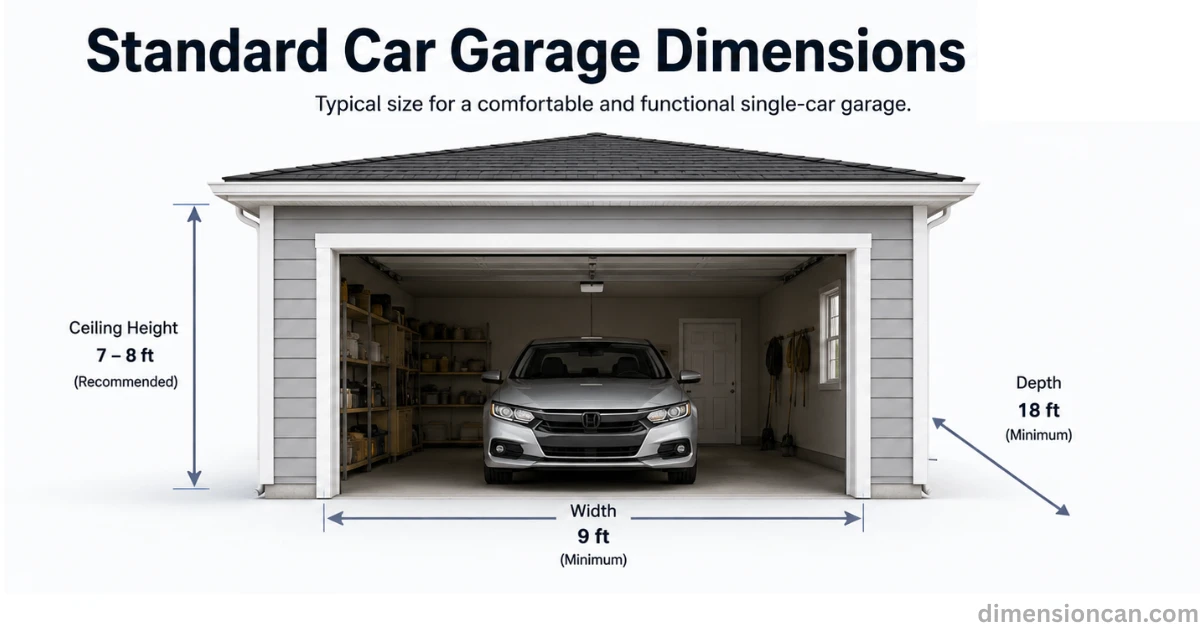
Choosing the correct garage size is not just about fitting your car inside. It affects your home value, your daily comfort, and even your ability to open car doors without hitting the wall.
This guide breaks down every garage dimension you need, from tiny single-car layouts to oversized four-car spaces.
What Are Standard Car Garage Dimensions?
The term car garage dimensions covers width, depth, and ceiling height. These three measurements decide whether your garage feels cramped or comfortable.
Most residential garages in the United States fall between 200 square feet and 900 square feet, depending on how many cars they hold. A sedan needs less room than a pickup truck or a full-size SUV.
Average Garage Size by Vehicle Type
A compact sedan fits comfortably in a space 9 feet wide by 18 feet long. An SUV or crossover typically needs 10 feet of width and 20 feet of depth.
Full-size pickup trucks often require 12 feet wide by 22-24 feet deep to leave room for the tailgate and mirrors.
Garage Dimensions vs. Parking Space Dimensions
A parking space in a lot or driveway is an open, unenclosed area, usually 9 feet wide by 18 feet long.
A garage, on the other hand, is an enclosed structure with walls, a roof, and a door, so it needs extra clearance for door swing, storage shelves, and walking space around the vehicle.
More Posts:Paint Can Dimensions: Sizes, Height & Diameter (2026)
2 Car Garage Dimensions
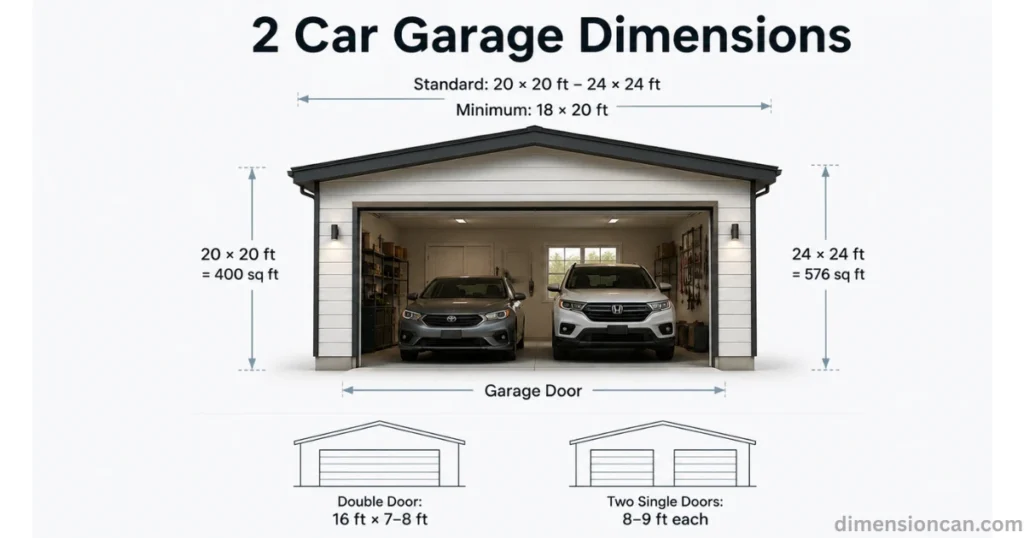
The 2 car garage dimensions most homeowners choose fall between 20×20 feet and 24×24 feet. This gives enough room for two midsize vehicles parked side by side, plus a narrow strip of space to walk between them.
Standard 2 Car Garage Size
A 20×20 foot garage offers 400 square feet of space and fits two average cars with limited extra room. A 22×22 foot garage adds breathing room for storage bins or a small workbench.
The 24×24 foot version, offering 576 square feet, is considered the oversized standard and comfortably handles SUVs, trucks, or a home gym corner.
Minimum 2 Car Garage Dimensions
The smallest workable 2 car garage size is 18×20 feet. This tight layout fits two compact cars but leaves almost no room for opening doors fully or storing extra items.
Anything narrower than 18 feet risks scraping mirrors or blocking door access entirely.
2 Car Garage Door Sizes
Most 2 car garages use one double-wide door, roughly 16 feet wide and 7 to 8 feet tall. Some homeowners instead choose two single doors, each about 8 to 9 feet wide.
Single doors cost more upfront but let you open one side without exposing the whole garage, which helps with temperature control and security.
More Posts:Baseball Field Dimensions: The Complete Guide by Age, League & Level
3 Car Garage Dimensions
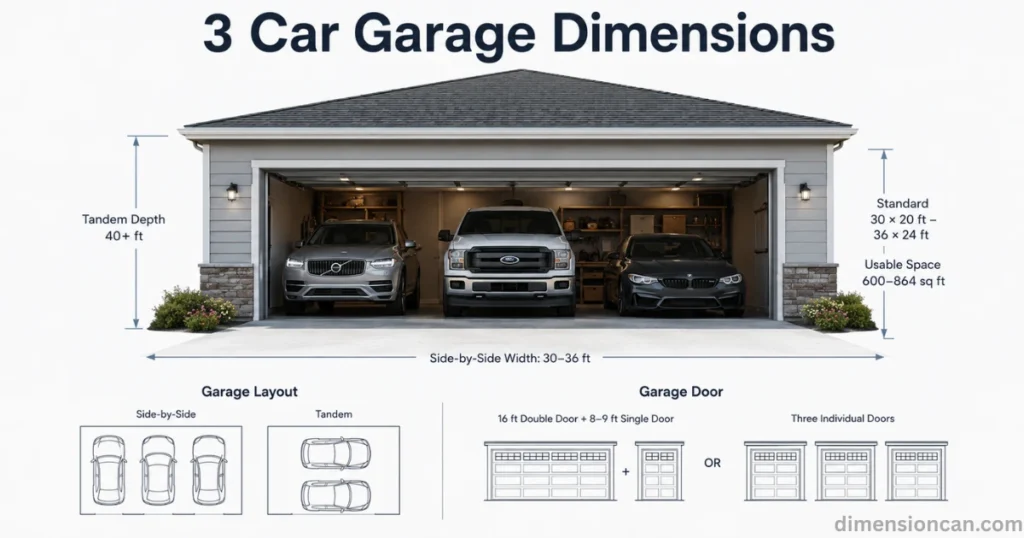
A 3 car garage needs significantly more square footage than a two-car layout. Typical 3 car garage dimensions start at 30×20 feet and stretch up to 36×24 feet, giving between 600 and 864 square feet of usable space.
Standard 3 Car Garage Size
A 30×20 foot garage works for three compact vehicles parked side by side. Homeowners with larger vehicles often prefer 32×22 feet or 36×24 feet, which allows for trucks, SUVs, and a dedicated workshop area without feeling cramped.
3 Car Garage Layout: Side-by-Side vs. Tandem
A side-by-side layout places all three vehicles in a row, requiring the full 30-36 foot width.
A tandem layout parks one car behind another, which saves width but adds depth, often stretching the garage to 40 feet deep or more. Tandem setups suit narrow lots but make it harder to move the rear vehicle without shifting the front one first.
3 Car Garage Door Sizes
Many 3 car garages combine one 16-foot double door with one 8-9 foot single door, or use three individual doors. This mixed setup balances cost, curb appeal, and flexible access for each vehicle.
1-Car and 4-Car Garage Dimensions
1 Car Garage Dimensions
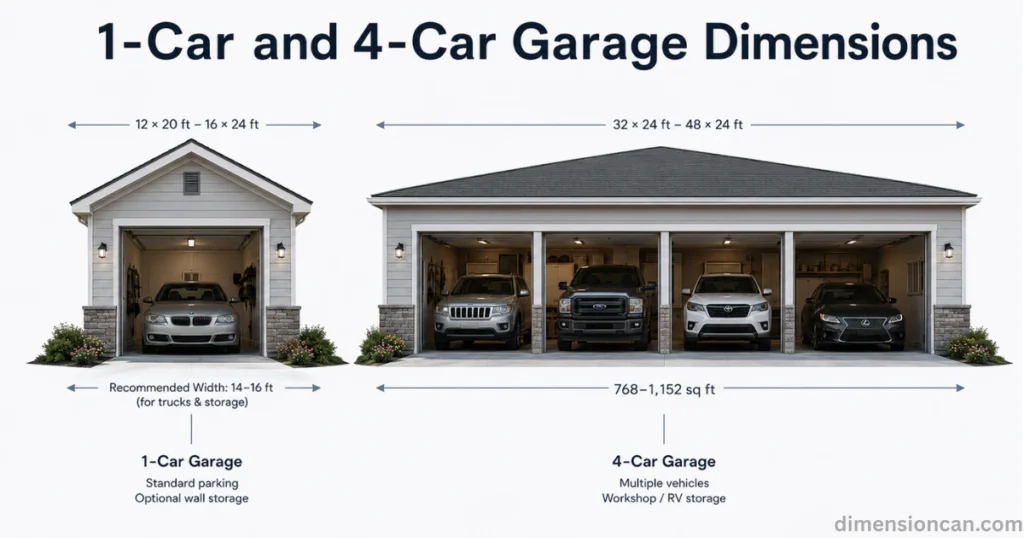
A single-car garage typically measures 12×20 feet at the low end and 16×24 feet for a roomier fit. The 12-foot width is tight for larger trucks, so a 14-16 foot width is recommended if you own a full-size vehicle or want storage shelving along the walls.
4 Car Garage Dimensions
Homeowners with multiple vehicles, a classic car collection, or heavy equipment often build 4 car garages ranging from 32×24 feet to 48×24 feet.
These larger structures, sometimes called RV garages or workshop garages, provide 768 to 1,152 square feet, enough for vehicles plus a dedicated work zone.
More Posts:Standard Bathtub Dimensions: A Complete Size Guide for Every Bathroom
Key Factors That Affect Garage Dimensions
Ceiling Height Requirements
Most garages have a ceiling height of 8 to 9 feet, which suits standard cars and light overhead storage. If you own a raised truck, plan to install a car lift, or want overhead storage racks, aim for 10 to 12 feet instead.
Vehicle Clearance & Door-Swing Space
Each parking spot inside a garage should allow at least 10 feet of width so doors can open fully without hitting the wall or the neighboring car. A minimum depth of 22 feet is recommended for standard vehicles, with extra depth needed for trucks or vehicles with trailer hitches.
Local Building Codes & Permit Requirements
Building codes vary by city and county across the USA, and they often dictate minimum setback distances, fire-rated walls between an attached garage and the home, and electrical requirements for outlets or openers.
Always check with your local permit office before finalizing garage dimensions, since a design that works in one state may not meet code in another.
Car Garage Dimensions FAQ’s
What are the standard dimensions of a 2 car garage?
A standard 2 car garage measures between 20×20 feet and 24×24 feet, giving 400 to 576 square feet of space for two vehicles.
What is the minimum size needed for two cars?
The smallest practical size is 18×20 feet. It fits two compact cars but offers little room for storage or fully opening doors.
What are the standard dimensions of a 3 car garage?
A 3 car garage typically ranges from 30×20 feet to 36×24 feet, depending on vehicle size and whether you want extra workspace.
Is 20 feet wide enough for a 2 car garage?
Yes, 20 feet wide works for two average-sized vehicles, though larger trucks or SUVs may feel tight without added width.
What size garage do I need for storage or a workspace?
For extra storage or a workspace, choose 22–24 feet in both width and depth. This gives room for shelving, tools, and a workbench.
Will a truck or SUV fit in a standard 20×20 garage?
It can fit, but space will be limited. A depth of 22–24 feet makes parking, door access, and movement much easier for larger vehicles.
What ceiling height should I plan for in a garage?
Plan for 8–9 feet for standard vehicles. Choose 10–12 feet if you plan to add a lift, taller vehicles, or overhead storage.
What are typical garage door sizes for 2-car and 3-car garages?
2 car garages commonly use a 16-foot double door. 3 car garages often add a second 8–9 foot single door for flexible access to each vehicle.

James Walker is a content researcher and writer specializing in dimensions, measurements, size comparisons, and conversion topics. He creates clear, practical, and easy-to-understand guides that help readers visualize and understand real-world measurements.