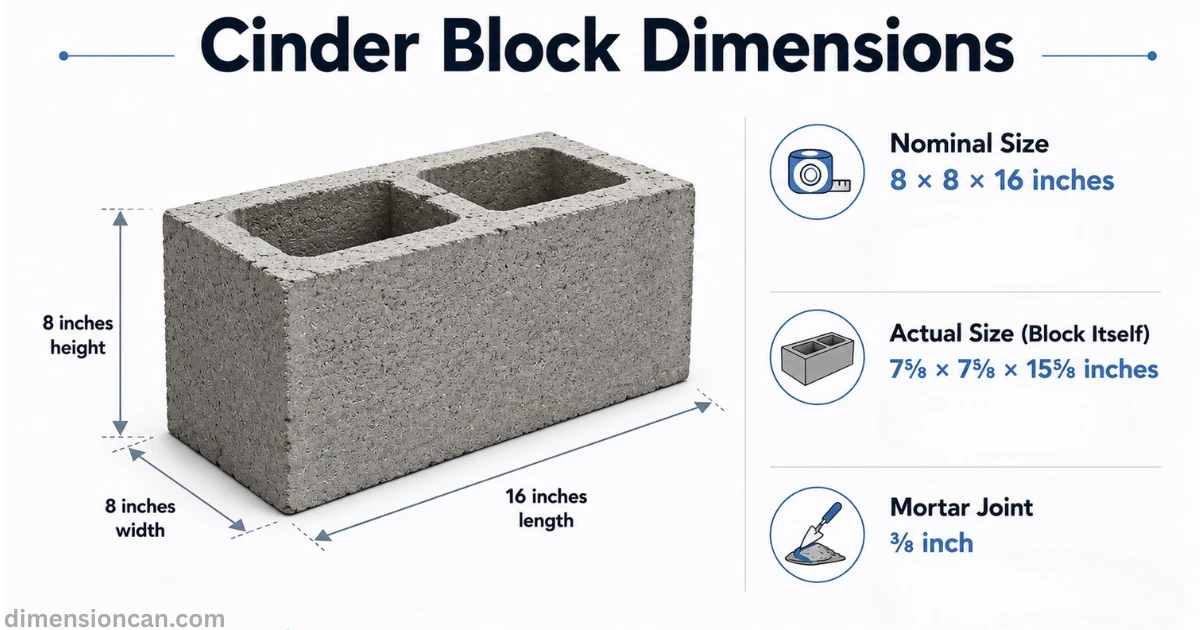
A standard cinder block measures 8 × 8 × 16 inches (nominal size). The actual size is 7⅝ × 7⅝ × 15⅝ inches because of the ⅜-inch mortar joint built into every wall.
This guide breaks down every common cinder block dimension, why it matters, and how to pick the right one for your project.
What Are Cinder Block Dimensions?
Nominal Cinder Block Dimensions Explained
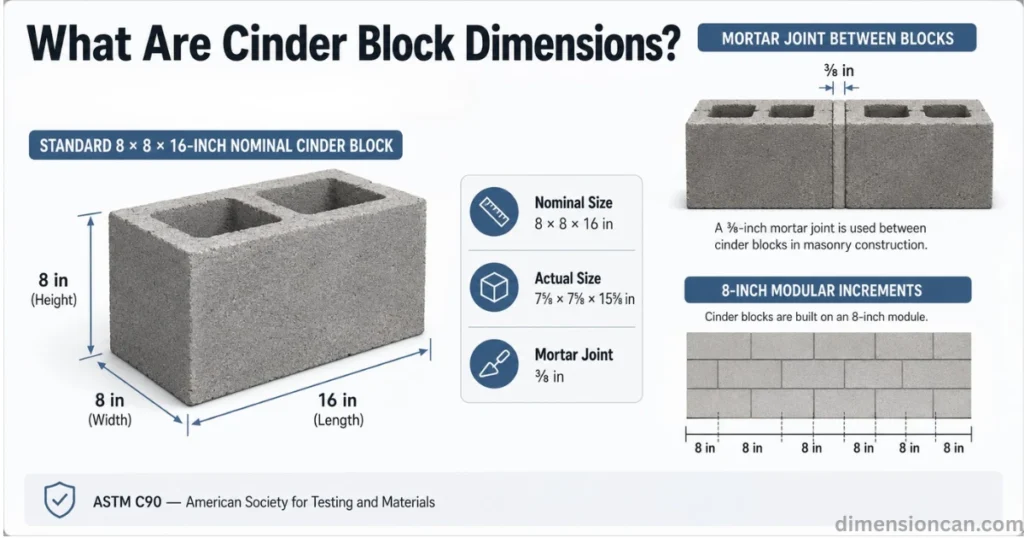
The nominal dimension is a planning number. It rounds up the real block size so it fits neatly into a modular grid. A wall built with 8-inch nominal blocks lines up in clean 8-inch increments. This makes layout, spacing, and material ordering much simpler for builders.
Actual Cinder Block Dimensions and the ⅜ Inch Mortar Gap
The actual dimension is always ⅜ inch smaller than the nominal size on each measured side. So an 8x8x16 nominal block is really 7⅝ x 7⅝ x 15⅝ inches. That missing ⅜ inch becomes the mortar joint once the block is laid. Skip this detail, and your wall length calculations will be off by inches over a long run.
- In the US, cinder block sizing follows the ASTM C90 standard, set by the American Society for Testing and Materials.
More Posts:IBC Tote Dimensions: 275, 330 & 550 Gallon Sizes in Inches
Standard Cinder Block Dimensions by Width
4 Inch Cinder Block Dimensions
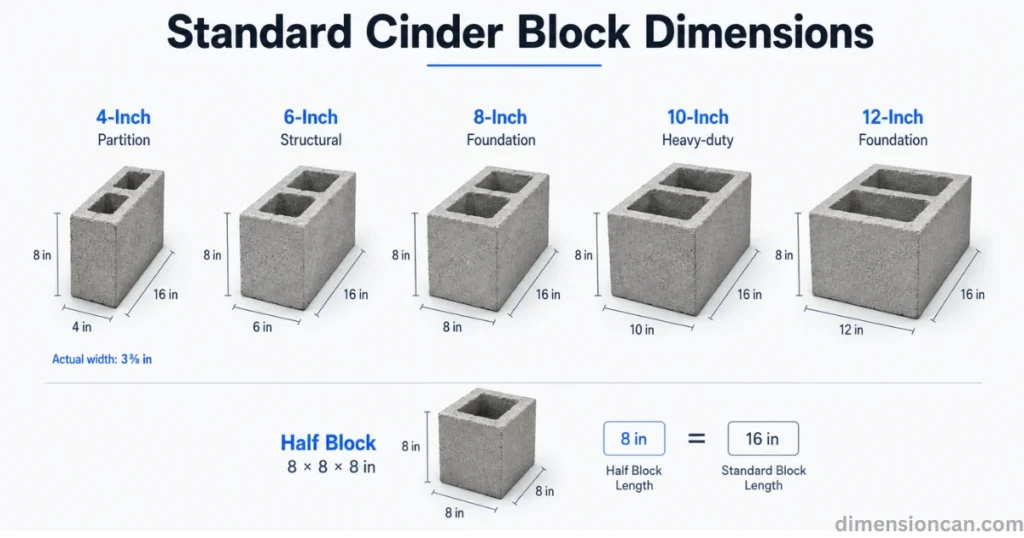
The 4-inch cinder block is the thinnest common size. It is used for non-load-bearing walls, like interior partitions or decorative garden edging. Its nominal size is 4 x 8 x 16 inches, with an actual width closer to 3⅝ inches.
6 Inch Cinder Block Dimensions
The 6-inch cinder block sits between light partition work and structural use. It offers more strength than the 4-inch block while staying easier to handle than heavier sizes.
Builders often choose it for interior load-bearing walls in smaller structures.
8 Inch Cinder Block Dimensions
The 8-inch cinder block is the most widely used size in the US. Its nominal dimensions are 8 x 8 x 16 inches.
This block handles exterior walls, foundations, and most load-bearing applications. If you only remember one cinder block size, this is the one.
10 Inch and 12 Inch Cinder Block Dimensions
The 10-inch and 12-inch cinder blocks are built for heavier structural demands. You will see these in multi-story buildings, retaining walls, and foundations that carry significant weight.
They are harder to lift and install, so labor costs run higher with these sizes.
Half Block Cinder Block Dimensions
Half blocks match the width and height of their full-size counterpart but measure only 8 inches long instead of 16.
Cinder Block Shapes and How Dimensions Change by Type
Stretcher, Corner, and Sash Block Dimensions
A stretcher block is the standard shape laid along a wall’s face.
Corner blocks have a flat, connector-free side for turning a wall at 90 degrees without exposing a rough edge. Sash blocks include a slot along one end, built to hold window or door frames securely in place.
Specialty Shapes: Bullnose, Bevel, and Pilaster Blocks
Bullnose blocks have one or two rounded edges for a softer, finished look on exposed corners.
Bevel blocks are cut at 45 degrees to form angled wall junctions.
Pilaster blocks create a wider column-like section within a wall, giving space for heavy vertical reinforcement like rebar.
More Posts:Kitchen Island Dimensions for Small & Large Kitchens
Cinder Block Dimensions vs. Other Masonry Units

Cinder Block vs. Concrete Block Dimensions
Cinder blocks and concrete blocks share the exact same standard dimensions. The difference is in the aggregate, not the size. Cinder blocks use fly ash or coal cinders as filler, making them lighter.
Concrete blocks use sand and gravel, making them denser and stronger. Both follow the same 8x8x16 nominal sizing under ASTM C90.
US Standard Sizes vs. Metric/International Cinder Block Dimensions
Outside the US, cinder block dimensions often shift to metric measurements. A common international size is 390mm x 190mm x 190mm, which is close to, but not identical to, the US standard.
If you’re sourcing blocks internationally or working on a project with imported materials, always confirm the metric equivalent before ordering to avoid mismatched wall courses.
FAQs About Cinder Block Dimensions
What is the standard size of a cinder block?
The standard cinder block size is 8 inches x 8 inches x 16 inches, nominal. The actual size measures 7⅝ x 7⅝ x 15⅝ inches once you account for the mortar joint.
How thick is a cinder block wall?
Wall thickness matches the block width used. Most load-bearing walls run 8 inches thick, while partition walls can be as thin as 4 to 6 inches.
Why is the actual size smaller than the nominal size?
The actual block is ⅜ inch smaller on each side to leave room for the mortar joint. Once mortared into place, the block fills back out to its full nominal size.
How many cinder blocks are in a square foot of wall?
A standard 8x8x16 block covers about 1.125 blocks per square foot of wall face, since each block covers roughly 0.89 square feet.
What size cinder block is used for a foundation?
Foundation walls typically use 8-inch to 12-inch cinder blocks, depending on the load and soil conditions. Thicker blocks are common for basement and retaining wall foundations.
Conclusion
Cinder block dimensions shape nearly every decision in a masonry project, from material orders to structural safety. The standard 8x8x16 nominal size covers most jobs, but width options from 4 to 12 inches give you flexibility for partitions, load-bearing walls, and heavy foundations.

James Walker is a content researcher and writer specializing in dimensions, measurements, size comparisons, and conversion topics. He creates clear, practical, and easy-to-understand guides that help readers visualize and understand real-world measurements.